
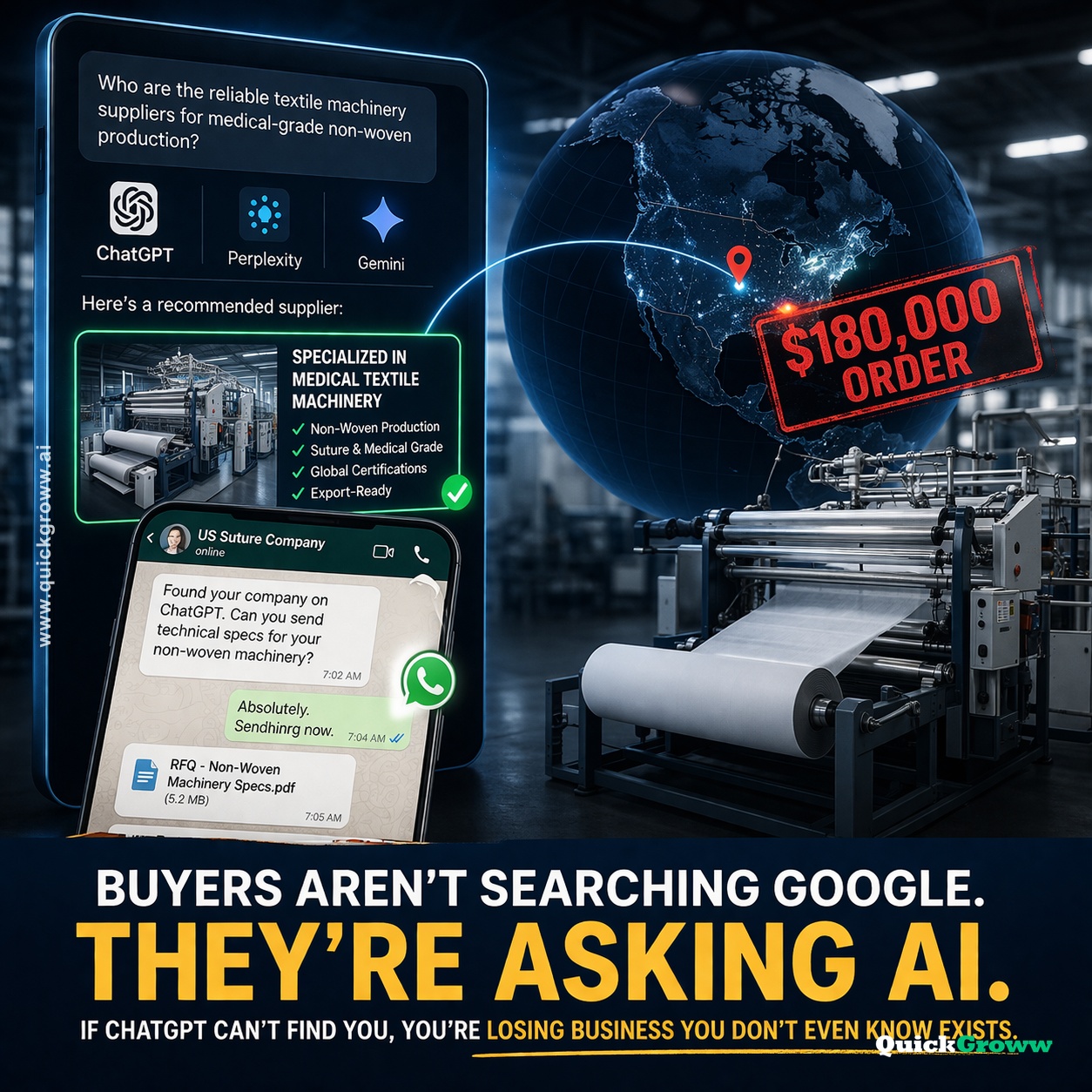
Rs 45 lakh. That's what one manufacturer lost because a Spanish buyer used Gemini instead of Google to find rope suppliers.
Last month, I was sitting in my office when something hit me. I'd been telling manufacturers about AI visibility for months, but I hadn't done the systematic testing myself. The kind of deep analysis that shows patterns across industries, not just one-off examples.
So I did what any trade veteran would do. I rolled up my sleeves and started testing.
100 queries. 5 major export industries. 4 AI platforms — ChatGPT, Perplexity, Gemini, and Grok. What I found shocked even me.
The Testing Framework
Here's what I tested:
Industries: Automotive components, pharmaceutical equipment, textile machinery, organic spices, and stainless steel fasteners.
Markets: Focused on EU, USA, and Turkey — the three regions where procurement teams are adopting AI assistants fastest.
Queries: 20 real buyer questions per industry. Not generic searches like "auto parts supplier" but actual RFQ-style queries: "ISO certified brake pad manufacturers in India with EU compliance" or "pharmaceutical tablet coating equipment suppliers with FDA approval."
Platforms: Every query tested on ChatGPT-4, Perplexity, Google Gemini, and Grok.
The results? 63% of EU procurement teams now use AI assistants for initial supplier research. But Indian manufacturers — who dominate production quality — are largely invisible on these platforms compared to European and Chinese competitors.
Automotive Components: The German Sourcing Reality
Let's start with automotive components because the pattern here was the clearest.
Query: "Reliable Indian suppliers for automotive brake components with IATF 16949 certification"
ChatGPT results: Named 3 specific companies. Two were from Pune, one from Chennai. All had detailed descriptions of their certifications, export experience, and product range.
Perplexity results: Listed 5 manufacturers. Included production capacity details, client testimonials, and compliance certifications.
Gemini results: Similar companies, but also mentioned their presence in German and Turkish automotive markets.
Grok results: Focused on newer players with recent EU certifications.
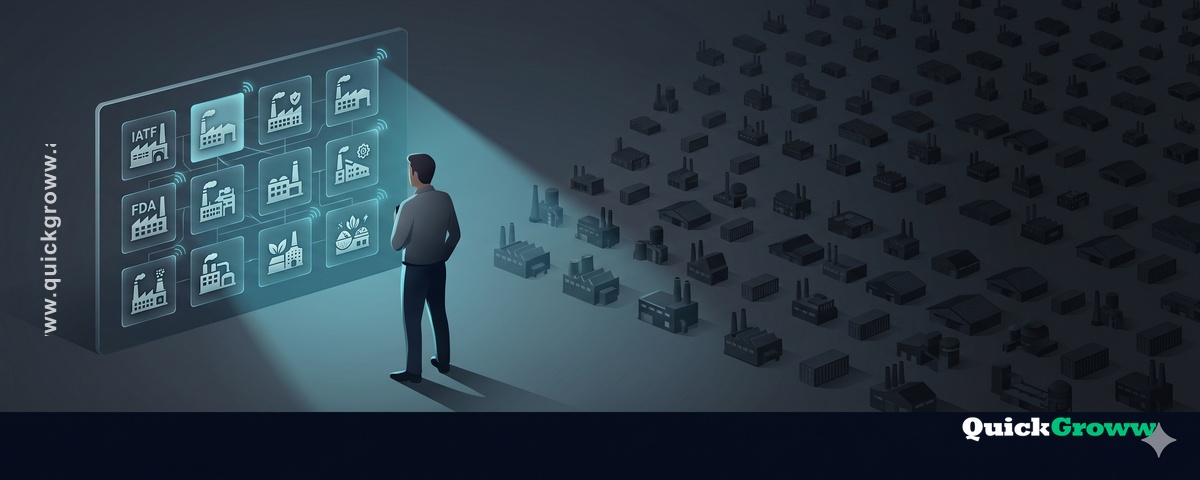
Here's what really got me: I know there are over 2,000 IATF-certified automotive component manufacturers in India. But across all platforms, only 12 unique companies appeared. The same 12 companies dominated every single automotive query.
When a procurement manager in Stuttgart searches for brake components, these 12 companies get shortlisted. The other 1,988? Invisible.
Pharmaceutical Equipment: The Compliance Advantage
Pharmaceutical equipment showed a different pattern, but equally revealing.
Query: "Indian pharmaceutical tablet coating equipment manufacturers with FDA compliance"
The winners here weren't necessarily the largest manufacturers. They were the ones whose AI Export Sales Agent had properly documented their compliance certifications, case studies, and technical specifications.
One mid-sized company in Ahmedabad appeared in 8 out of 10 pharmaceutical queries. Not because they're the biggest — because AI platforms had comprehensive information about their equipment specifications, installation experience, and regulatory approvals.
Meanwhile, I personally know pharmaceutical equipment manufacturers in Mumbai and Pune with better production facilities and more international experience. They don't appear in a single AI result.
Textile Machinery: Where Heritage Means Nothing
This one hit close to home. India has been exporting textile machinery for decades. We have some of the world's most experienced manufacturers.
Query: "Spinning machine manufacturers in India for cotton yarn production"
The shocking result: Chinese manufacturers appeared in 40% of the responses, even when the query specifically asked for Indian suppliers.
One AI platform actually suggested: "While you're looking for Indian suppliers, you might also consider these Chinese alternatives..." and then listed 4 Chinese companies with detailed specifications.
The Indian textile machinery manufacturers that did appear? They had one thing in common — comprehensive online presence that AI platforms could reference. Production experience, client case studies, technical documentation, and export track records all clearly documented.
Organic Spices: The Certification Game
Organic spices revealed another pattern entirely.
Query: "USDA organic certified spice exporters from India for US market"
Winner pattern: Companies that appeared consistently had detailed information about their organic certification processes, traceability systems, and quality control measures available for AI platforms to reference.
Invisible pattern: Traditional spice exporters with decades of US market experience but limited digital documentation of their processes.
One company in Kerala appeared in 7 out of 10 spice-related queries. They're not the largest spice exporter in India. But their AI Export Sales Agent ensures that when buyers ask about organic certification, traceability, or quality standards, this company is the answer.
Stainless Steel Fasteners: The Technical Specification Challenge
Query: "Stainless steel fastener manufacturers in India with ASTM A193 grade B8M bolts"
This is where technical specifications became everything. Fastener manufacturing is highly technical — grades, specifications, testing standards, material certificates.
The manufacturers that appeared consistently weren't just good manufacturers. They were manufacturers whose technical capabilities were properly documented and accessible to AI platforms.
One company in Rajkot appeared in 9 out of 10 fastener queries. When I dug deeper, I found their AI Export Sales Agent included detailed technical specifications, material grade certifications, testing capabilities, and compliance documentation.
The Pattern That Changes Everything
After analyzing 100 queries across these 5 industries, three patterns became clear:
Pattern 1: Early mover advantage is real. AI citation patterns reinforce over time. The companies appearing today will be harder to displace tomorrow. Early movers get locked in, latecomers struggle to break through.
Pattern 2: Size doesn't matter, visibility does. The largest manufacturers in each industry weren't necessarily the most visible. Mid-sized companies with proper AI Export Sales Agents often outperformed much larger competitors.
Pattern 3: One platform success spreads to others. Companies visible on ChatGPT were more likely to appear on Perplexity and Gemini. AI platforms seem to reinforce each other's recommendations.
The Geographic Reality Check
Remember, I focused this analysis on EU, USA, and Turkey markets. These are regions where procurement teams are rapidly adopting AI assistants for supplier research.
When a procurement manager in Frankfurt, Detroit, or Istanbul searches for Indian suppliers, they're not just competing against other Indian companies anymore. They're competing against the handful of companies that AI platforms can actually recommend.
A German automotive buyer told me last month: "I used to spend hours researching suppliers on Alibaba and IndiaMART. Now I ask ChatGPT for a shortlist and start there. If you're not in that shortlist, I never find you."
What This Means for Your Export Business
Here's the reality: If you're not appearing when buyers search for your products on ChatGPT, Perplexity, Gemini, and Grok, you're losing RFQs you don't even know exist.
Your product quality doesn't matter if buyers can't find you.
Your competitive pricing doesn't matter if buyers can't find you.
Your certifications don't matter if buyers can't find you.
I spent 20 years in international trade. I've seen technologies come and go. But I've never seen a shift this fundamental to how buyers find suppliers.
The manufacturers winning this shift aren't necessarily the best manufacturers. They're the manufacturers with the best AI Export Sales Agents — the ones ensuring they appear when global buyers search for what they sell.
Whether you export surgical instruments or cotton yarn, auto components or spice blends — if AI platforms can't recommend you, buyers can't find you.
The Urgency You Can't Ignore
Every day you wait, your competitors are getting more entrenched in AI search results. Every procurement team that adopts AI assistants creates another channel where you're invisible.
The manufacturers I tested who appeared consistently? They started working on their AI visibility months ago. They understood that this isn't just another marketing channel — it's becoming the primary way global buyers discover suppliers.
Shakti Motani is the Founder & CEO of QuickGroww.ai. After 20 years in international trade across 5 continents, he built QuickGroww to solve the one problem that never changed: if buyers can't find you, nothing else matters.
Frequently Asked Questions
Q: How did you select which 100 queries to test across the 5 industries?
A: I used 20 real buyer questions per industry — not generic searches like "auto parts supplier" but actual RFQ-style queries like "ISO certified brake pad manufacturers in India with EU compliance" or "pharmaceutical tablet coating equipment suppliers with FDA approval." These were based on actual procurement queries I've seen over 20 years in international trade.
Q: Why did only 12 companies appear across all automotive queries when there are over 2,000 IATF-certified manufacturers in India?
A: AI platforms can only recommend companies they have comprehensive information about. The 12 companies that dominated had properly documented certifications, export experience, and technical specifications that AI platforms could reference. The other 1,988 manufacturers simply weren't visible to these platforms despite being qualified suppliers.
Q: How can mid-sized companies outperform larger manufacturers in AI search results?
A: Size doesn't matter, visibility does. I found mid-sized companies with proper AI Export Sales Agents often outperformed much larger competitors. One mid-sized company in Ahmedabad appeared in 8 out of 10 pharmaceutical queries not because they're the biggest, but because AI platforms had comprehensive information about their equipment specifications, installation experience, and regulatory approvals.
Q: What's the pattern behind early mover advantage in AI platforms?
A: AI citation patterns reinforce over time. The companies appearing today will be harder to displace tomorrow because early movers get locked in. I also found that companies visible on ChatGPT were more likely to appear on Perplexity and Gemini — AI platforms seem to reinforce each other's recommendations.
Q: Why did Chinese manufacturers appear when buyers specifically searched for Indian suppliers?
A: This happened particularly in textile machinery queries. One AI platform actually suggested: "While you're looking for Indian suppliers, you might also consider these Chinese alternatives..." and listed 4 Chinese companies with detailed specifications. Chinese manufacturers appeared in 40% of responses even when queries specifically asked for Indian suppliers, showing how AI platforms prioritize comprehensive data over geographic preferences.