
The Problem Nobody Talks About at Trade Shows
You spent money on a website. Your team wrote product pages. Maybe you even hired someone to do "SEO."
And yet the inquiries aren't coming.
Here's what most manufacturers and exporters don't want to hear: you are probably ranking for words nobody searches. Or worse — words that attract people who will never buy from you.
This is not a theory. QuickGroww sees it constantly when running Golden Keyword Analysis for exporters across surgical instruments, organic spices, auto components, stainless steel fasteners, textile machinery, and a dozen other categories. The pattern repeats, almost without exception.
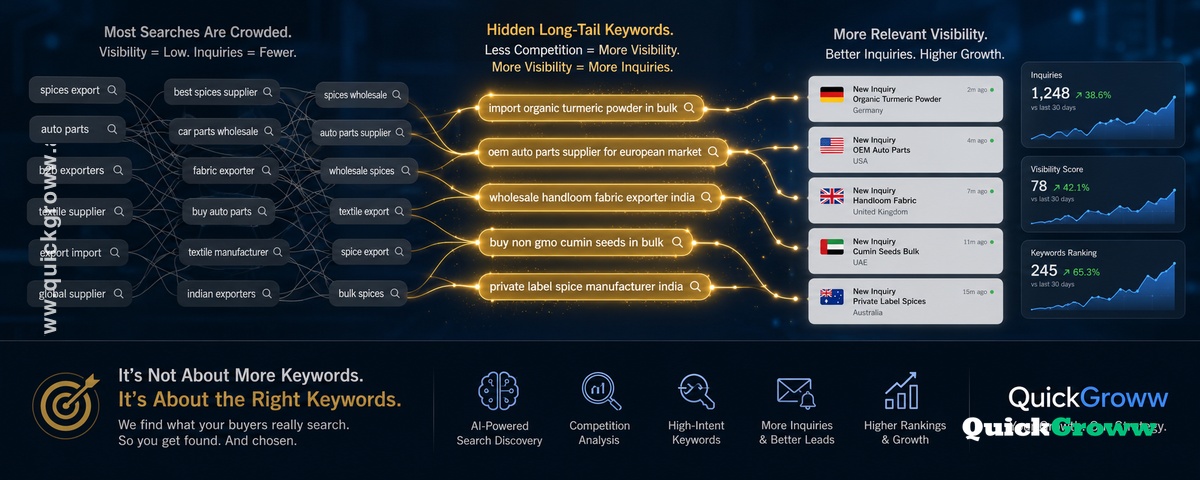
Businesses chase the obvious terms. They optimise for the words their competitors also fight over. They build pages around what they think buyers type. And they miss — completely miss — the phrases that actually convert into RFQs.
The good news is that the data exists to fix this. Live SERP data. Real search volumes. Autocomplete signals. People-Also-Ask mining. QuickGroww's Golden Keyword Analysis pulls all of it together and maps it to one thing: the terms that print inquiries.
Let's get into exactly how this works.
Where the Data Comes From — and Why It's Not Guesswork
QuickGroww uses DataForSEO as the underlying data source for this analysis. That's not a casual choice.
DataForSEO pulls live SERP data and real search volumes — not estimates based on panel data from a year ago. When a buyer in Germany types a query into Google looking for a cotton yarn supplier, that search event gets logged. When a procurement manager in the UAE asks Perplexity which pharmaceutical equipment manufacturers in India are worth contacting, the underlying query patterns leave traces.
The analysis layers three inputs on top of that live volume data:
Autocomplete mining. When you type "stainless steel fasteners" into Google, the autocomplete suggestions finish that phrase in different ways depending on what real users have searched before. "Stainless steel fasteners ISO standard export" is different from "stainless steel fasteners wholesale price." Both matter. Neither is obvious without the data.
People-Also-Ask mining. The PAA boxes on Google search results reveal what buyers are actually uncertain about. These are not keyword phrases — they're full questions. "What is the minimum order quantity for surgical instruments from India?" is a PAA-style question that reveals intent. A product page that answers that question is more likely to appear when a buyer asks ChatGPT or Gemini the same thing in a conversational format.
Industry synonym mapping. This is the part that surprises most exporters. Buyers don't always use the same terminology suppliers use. A leather goods exporter might optimise for "full-grain leather bags wholesale" when international buyers are actually typing "genuine leather bags bulk supplier." Same product. Different vocabulary. Zero overlap in the search results.
QuickGroww maps those synonyms — exact product names, regional terminology variations, industry-specific codes — so that the keyword list you end up with reflects buyer language, not internal jargon.
Money Keywords vs. Awareness Keywords — This Distinction Changes Everything
Once the data is collected, QuickGroww sorts every keyword into one of two buckets.
Money keywords carry clear purchase or RFQ intent. Someone searching these terms is either ready to send an inquiry or actively building a supplier shortlist. For a chemical exporter, a money keyword might look like "sodium silicate export price FOB Mumbai." For an engineering tools manufacturer, it might be "precision boring tools DIN standard MOQ." These phrases signal that the person on the other end of the search is a buyer, not a student, not a researcher, not a competitor.
Awareness keywords bring traffic, but rarely inquiries. Someone searching "how is cotton yarn made" is curious. They might be a college student. They might be a journalist writing a feature. They might even be a buyer doing background research at the very beginning of a very long procurement cycle. But they are not sending you an RFQ today.
Most businesses treat all keywords the same. They optimise every page for whatever has the highest search volume and call it done.
That's the mistake.
A page targeting an awareness keyword can rank #1 on Google and still generate zero inquiries in twelve months. Meanwhile, a page targeting a money keyword with one-tenth the search volume might produce three qualified RFQs in a week.
This is why the distinction matters. It's also why QuickGroww's Golden Keyword Analysis delivers a prioritised map — not just a list. Money keywords sit at the top. Awareness keywords are tracked separately.
What the Analysis Actually Reveals for Exporters
Let's make this concrete, because abstract explanations only go so far.
Consider an organic spices exporter. Their existing product pages are optimised for terms like "organic turmeric powder" and "cumin seeds organic." High competition. Dozens of competitors targeting exactly the same phrases. The exporter is on page three of Google, generating almost no organic traffic.
The Golden Keyword Analysis reveals something different. Buyers are searching "organic turmeric powder USDA certified bulk" and "cumin seeds non-irradiated export certificate." These longer, more specific phrases have lower raw volume — but they carry unmistakable purchase intent. And the exporter's competitors aren't targeting them at all.
Or take a pharmaceutical equipment manufacturer. They've optimised for "tablet press machine" — a phrase with enormous search volume and brutal competition from global manufacturers. The Golden Keyword Analysis shows that buyers evaluating suppliers are actually using phrases like "rotary tablet press GMP certified supplier" and "pharmaceutical tablet press CE certification export." The manufacturer wasn't ranking for either. Neither were most of their competitors.
This pattern — high-intent, specific, under-contested phrases hiding just below the obvious terms — appears across categories. Stainless steel fasteners. Leather goods. Textile machinery. Auto components. The specific phrases change. The underlying dynamic doesn't.
And this matters more than ever because of where buyers are now going to find suppliers.
The AI Search Layer — Why ChatGPT, Perplexity, Gemini, and Grok Change the Stakes
Here's something most exporters haven't fully processed yet.
A growing number of global buyers don't start their supplier search on Google anymore. They open ChatGPT and type a question. They ask Perplexity to build them a shortlist of verified suppliers. They use Gemini to research a product category before they ever visit a company website. Grok surfaces information from live web data in ways that traditional search doesn't.
When a buyer asks ChatGPT "which Indian manufacturers supply ISO-certified surgical instruments in bulk," ChatGPT synthesises an answer from the content it can access and has learned from. That answer includes company names — or it doesn't. Suppliers who appear in that answer are on the buyer shortlist before a single email is sent. Suppliers who don't appear might never hear about the RFQ at all.
The content that feeds those AI-generated answers is built on the same keyword logic that governs traditional search. Pages that clearly answer specific, intent-driven questions — using the exact terminology buyers use — are more likely to appear in what ChatGPT, Perplexity, Gemini, and Grok surface.
This is why the Golden Keyword Analysis isn't just a traditional SEO exercise. It's a supplier discoverability exercise. The money keywords that drive organic search traffic are often the same phrases that determine which suppliers appear when Perplexity builds a buyer's shortlist.
QuickGroww's AI Export Sales Agent is designed exactly for this reality — getting manufacturers and exporters onto the right shortlists before the buyer ever sends a formal inquiry. But that visibility starts with knowing which phrases buyers actually use.
The Deliverable — What You Get from a Golden Keyword Analysis
The output of a QuickGroww Golden Keyword Analysis is a prioritised keyword map.
Not a spreadsheet of five hundred keywords with volume numbers attached. A map. Structured, prioritised, actionable.
Every keyword in the map is tagged with its search volume (from live DataForSEO data, not estimates), its intent classification (money or awareness), and its competitive density. The money keywords come first. The ones where your competitors haven't yet built strong pages come first among those.
The map tells you, product by product and category by category, which words to target on which pages. It eliminates the guesswork about what to write. It stops the pattern of ranking for terms nobody searches.
For exporters building out content for ChatGPT and Perplexity visibility, the map also identifies the question-format phrases — pulled from People-Also-Ask data — that translate directly into the conversational queries buyers now type into AI assistants.
A cotton yarn manufacturer using this analysis doesn't have to wonder whether to target "cotton yarn combed" or "combed cotton yarn ring spun export." The data answers that. A leather goods exporter doesn't have to guess whether buyers use "genuine leather" or "full-grain leather" in search. The autocomplete data tells them.
That specificity is the point. Inquiry flow starts with the right words on the right pages.
Frequently Asked Questions
Q: What is DataForSEO and why does QuickGroww use it for keyword analysis?
A: DataForSEO is the underlying data source QuickGroww uses to pull live SERP data and real search volumes. Unlike panel-based tools that estimate volume from historical data, DataForSEO captures current search behavior, which means the keyword volumes in the Golden Keyword Analysis reflect what buyers are actually typing right now.
Q: What is the difference between a money keyword and an awareness keyword?
A: Money keywords carry clear purchase or RFQ intent — the person searching is ready to contact a supplier or build a shortlist. Awareness keywords bring traffic from people who are curious or researching but are not ready to send an inquiry. QuickGroww's analysis separates these two buckets so exporters can prioritise pages that generate actual inquiries.
Q: Why does it matter which keywords I target if I'm already ranking on Google?
A: Ranking position is only half the equation. You can rank #1 for a term that generates zero inquiries if that term attracts the wrong audience or has near-zero search volume. The Golden Keyword Analysis ensures you rank for terms that combine real volume with genuine purchase intent.
Q: How does the keyword analysis connect to visibility on ChatGPT, Perplexity, Gemini, and Grok?
A: These AI assistants synthesise answers from content they can access, and they tend to surface suppliers whose pages clearly answer the specific, intent-driven questions buyers ask. The same money keywords and People-Also-Ask phrases that drive organic search traffic also influence which suppliers appear when a buyer asks Perplexity or ChatGPT to recommend vendors in a category.
Q: Which industries does this analysis apply to?
A: The analysis applies across any export category. QuickGroww has run it for manufacturers in surgical instruments, organic spices, auto components, pharmaceutical equipment, stainless steel fasteners, textile machinery, cotton yarn, chemical exporters, leather goods, and engineering tools, among others. The data inputs and methodology are the same across categories — only the specific keywords differ.
Curious how your own company shows up on AI? → https://quickgroww.ai/ai-visibility-scanner