
The Problem Isn't Your Product. It's How You're Described.
Here's what happens dozens of times a day across surgical instrument exporters in Sialkot, cotton yarn mills in Coimbatore, stainless steel fastener manufacturers in Aligarh, and organic spice processors in Rajkot.
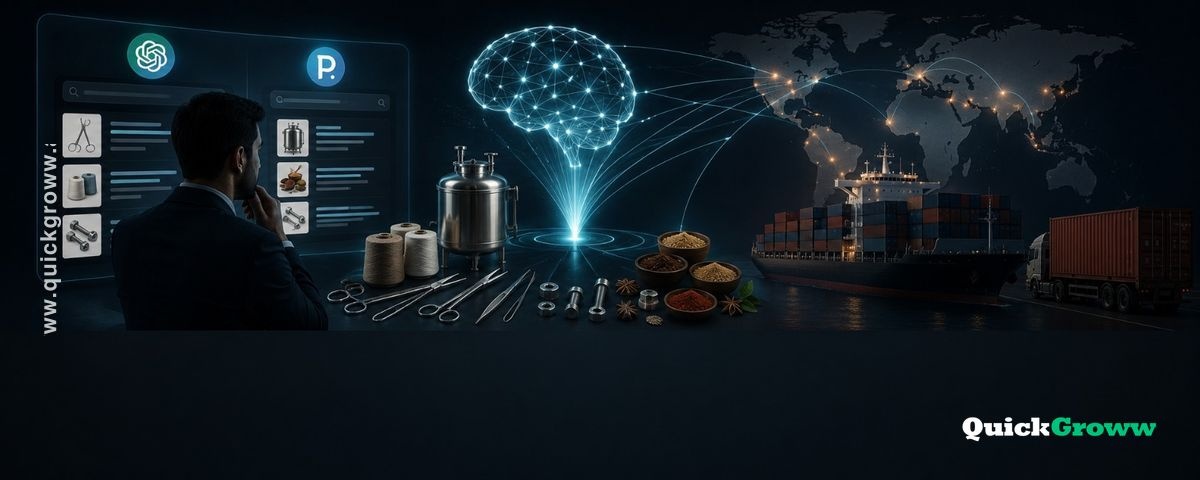
A buyer opens ChatGPT or Perplexity. Types something specific. "Pharmaceutical equipment supplier India GMP certified small batch," or "surgical instruments exporter OEM private label," or "organic turmeric powder bulk export food grade."
ChatGPT gives three names. Sometimes four. The buyer shortlists from those.
Your company isn't there.
Not because your product is wrong. Not because your pricing is off. Because the content describing your business — on your website, your trade profiles, your product pages — wasn't built from your actual business. It was built from keywords. And keywords without context look thin when an AI like Gemini or Grok tries to match a buyer's specific query to a specific supplier.
This is the gap QuickGroww's AI Export Sales Agent was built to close.
And the starting point isn't content. It's understanding.
What "Learning the Business the Way a Buyer Does" Actually Means
Most agencies start with a content calendar. Or a keyword list. Or a competitor audit.
QuickGroww starts differently.
The first step is a Business, Product and Market Analysis. It's a structured process of learning your business the same way a serious global buyer would learn it — before they send an RFQ, before they request a sample, before they shortlist you.
What does that mean in practice?
It means mapping your actual products. Not category-level descriptions. Specific products. An auto components manufacturer in Pune doesn't just make "auto parts" — they might make precision-machined brake caliper brackets in grades EN8 and EN19, supplied to Tier 1 assemblers in Germany and South Korea, with wall thickness tolerances of ±0.02mm. That's what the AI needs to see. That's what earns the citation.
It means documenting real use-cases. A leather goods exporter in Kanpur making vegetable-tanned leather wallets for European slow-fashion brands has a very different use-case profile than one making machine-stitched promotional merchandise for US corporate buyers. Same raw material. Completely different buyer language. Completely different AI query patterns.
It means capturing the materials and sectors you actually serve. A textile machinery manufacturer serving technical textile producers in Turkey has different category presence needs than one serving denim mills in Bangladesh. The sectors matter. The materials matter. Both determine how ChatGPT frames a recommended supplier when a buyer asks.
It means understanding price positioning — not as a number, but as a market signal. A chemical exporter competing on industrial-grade commodity pricing needs different content than one exporting specialty, food-safe or pharma-grade chemicals at a premium. These aren't the same buyer. They don't search the same way.
And it means capturing the actual language of your market. Not the language your marketing team uses. The language your buyers use when they're sitting in Rotterdam or Seoul or Cairo, describing what they need to ChatGPT at 11pm before a morning sourcing call.
This becomes the ground-truth brief.
Everything else — every product page, every application note, every schema tag, every export profile — is built from that brief.
Why Generic Content Fails AI Shortlisting
Let's be direct about what's happening when Perplexity or Gemini builds a supplier shortlist.
These systems are reading your content and asking: does this supplier match what the buyer needs? Not approximately. Specifically.
A buyer querying Grok for "engineering tools manufacturer India HSS grade export ready CE certified" is going to get a response built from suppliers whose content actually says those words — in context, connected to real applications, backed by product-level detail. Not a homepage that says "We are a leading manufacturer of quality tools with decades of experience."
That homepage gets ignored. Not penalized. Ignored. It offers nothing to anchor the match.
This is what QuickGroww means when it says content not grounded in real products and applications "reads thin to buyers and to AI." It's not a metaphor. When ChatGPT reads your content and tries to determine whether you make HSS-grade engineering tools for export in CE-certified configurations, the answer needs to be there — explicitly, at the product level, with application context. Otherwise ChatGPT hedges, or picks someone else who made it obvious.
Generic agencies write for keywords because keywords are measurable and keywords are sellable. But a keyword like "surgical instruments manufacturer" on a page with no mention of material grades, sterilization compatibility, OEM customization, minimum order quantities, or certification standards is not useful to an AI system trying to shortlist a supplier for a buyer in Germany who needs exactly those things.
It's not that the keyword is wrong. It's that the keyword is all there is.
QuickGroww's AI Export Sales Agent is designed to fix this. Not by stuffing more keywords. By building content that answers the specific questions a real buyer would ask — because the brief starts with those questions.
What the Product-and-Market Map Delivers
The output of the Business, Product and Market Analysis is a structured map.
Products. Applications. Materials. Sectors. Differentiators.
That sounds simple. It's not.
For a cotton yarn exporter in Tamil Nadu, the product map distinguishes between combed and carded constructions, count ranges, ply configurations, end-use applications (hosiery versus wovens versus technical fabric), certifications (GOTS, OEKO-TEX), and buyer geographies. Each of those dimensions becomes a content anchor.
For a pharmaceutical equipment manufacturer, the map captures GMP compliance levels, machine types, batch size ranges, material-contact specifications, regulatory markets served (EU, US FDA, WHO), and specific applications (tablet compression, blister packaging, API reactors). A buyer asking ChatGPT "WHO-GMP-compliant pharmaceutical equipment supplier India for small batch tablet manufacturing" needs to find content that directly maps to that query — not a general page about pharmaceutical machinery.
For a stainless steel fastener exporter, the map documents grades (304, 316, 316L, duplex), head types, drive types, thread standards (DIN, ISO, ASTM), surface finishes, end markets (marine, food processing, chemical plant), and certifications. A fastener is not a fastener to a buyer. An M12 316L hex bolt with a DIN 933 thread for a marine application is a specific thing. The content has to be specific.
This map is what "drives everything downstream" — not as a slogan, but as a workflow. Every asset QuickGroww's AI Export Sales Agent produces is traceable back to something in that map. If it's not in the map, it doesn't get written. If it is in the map, it gets written with the right specificity, in the right language, for the right buyer.
The alternative — writing first, mapping later, or not mapping at all — produces content that looks complete on the surface and performs nothing in the shortlist.
The Inquiry Flow That Makes This Concrete
Here's what the difference looks like in the inquiry flow.
An organic spice exporter runs with generic website copy for two years. Their pages say "premium quality spices" and "trusted by buyers worldwide." ChatGPT, asked by a buyer in Europe for "organic cumin seeds export India non-irradiated EU compliant," returns nothing from this exporter. The content doesn't signal EU compliance. It doesn't signal non-irradiation. It doesn't signal organic certification (India Organic, USDA NOP, EU 834/2007). The match fails. No inquiry.
The same exporter goes through QuickGroww's Business, Product and Market Analysis. The brief captures: cumin seeds, coriander seeds, fenugreek; all USDA NOP and EU 834/2007 certified; non-irradiated and steam-sterilized options; bulk 25kg and 50kg packaging; moisture specs; documented traceability to farm level; target buyer sectors (food manufacturing, Ayurvedic processing, private label retail). Product pages are rebuilt from that map. Schema is applied. The content answers the buyer's actual question.
Three months later, a European food manufacturer asks Perplexity the same query. The exporter appears. The buyer clicks. The inquiry comes in.
The product didn't change. The pricing didn't change. The business didn't change.
The description of the business changed. And that description was built from the ground up, starting with a real map of what the business actually is.
That's what QuickGroww's AI Export Sales Agent does. And it starts before a single word of content is written.
Frequently Asked Questions
Q: What exactly is the Business, Product and Market Analysis that QuickGroww conducts?
A: It's a structured process of learning a manufacturer's or exporter's business the way a global buyer would — mapping real products, use-cases, materials, sectors served, price positioning, and the actual language buyers use when they search. The output is a ground-truth brief that drives every content asset built afterward.
Q: Why does content built from keywords alone fail to generate inquiries from ChatGPT or Perplexity?
A: AI systems like ChatGPT and Perplexity try to match a buyer's specific query to a specific supplier. If content doesn't include the application context, material grades, certifications, and sector language the buyer is using, the AI cannot make the match — and the supplier is excluded from the shortlist. Keywords without context read as thin and generate no citation.
Q: Which types of exporters does this approach apply to?
A: The approach applies across manufacturing and export categories — including surgical instruments, cotton yarn, auto components, pharmaceutical equipment, stainless steel fasteners, organic spices, textile machinery, chemical exporters, leather goods, and engineering tools. Any exporter whose buyers are using ChatGPT, Perplexity, Gemini, or Grok to shortlist suppliers stands to benefit from content grounded in real product and application data.
Q: What does "ground-truth brief" mean in this context?
A: It's the structured product-and-market map that captures everything specific about a business — products, applications, materials, sectors, differentiators — in the language buyers actually use. Every piece of content QuickGroww's AI Export Sales Agent produces is built from this brief, not from generic templates or keyword lists.
Q: How does the structured map affect what buyers see when they ask an AI for supplier recommendations?
A: When an AI like Gemini or Grok reads content built from a structured map, it finds the specific terms, certifications, applications, and material grades that match a buyer's query. This increases the probability that the supplier appears in the AI's response and on the buyer's shortlist — driving real inquiry flow rather than anonymous website traffic.
Curious how your own company shows up on AI? → https://quickgroww.ai/ai-visibility-scanner