

When was the last time you opened ChatGPT and searched for your own product?
Every manufacturer asks me the same question: "How do I get my company to appear when buyers ask AI about my products?" After 20 years in international trade and building QuickGroww from the ground up, I've developed a complete framework that works.
Last month, I sat with an automotive components manufacturer in São Paulo. He pulled out his phone, opened ChatGPT, and typed "brake disc suppliers Brazil." His company — ISO certified, exports to 12 countries, best prices in the market — was nowhere in the response.
"That's not possible," he said. "We spend R$15,000 per month on marketing."
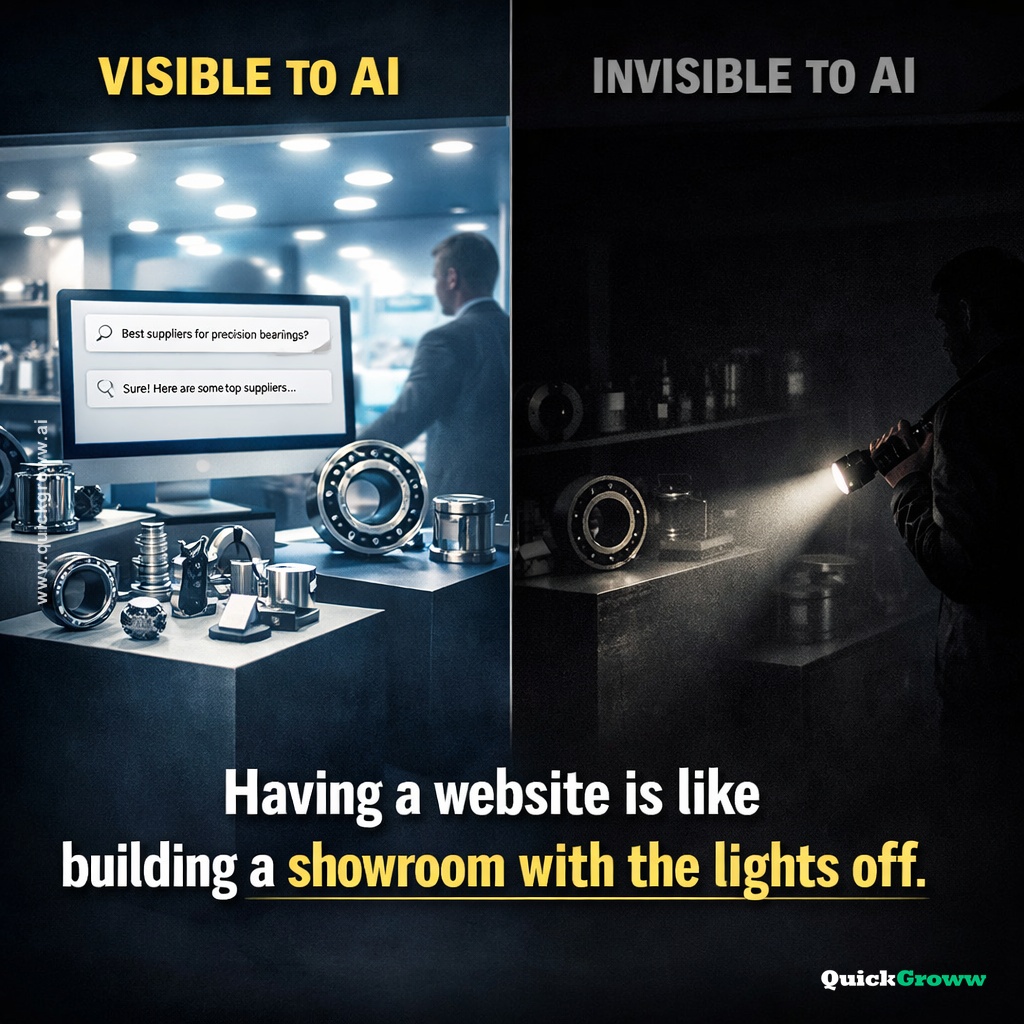
Here's what I learned from 20 years of watching great manufacturers lose to inferior competitors: if buyers can't find you, nothing else matters. Your certifications, your prices, your quality — irrelevant if you're invisible.
Understanding Why Your Website Fails on AI Platforms
Let me tell you about the biscuit and the cow.
You hand a biscuit packet to a human. They see the brand, read the ingredients, understand the flavors. Hand the same packet to a cow. The cow doesn't care about your brand story or your ingredient list. It just wants to know: can I eat this?
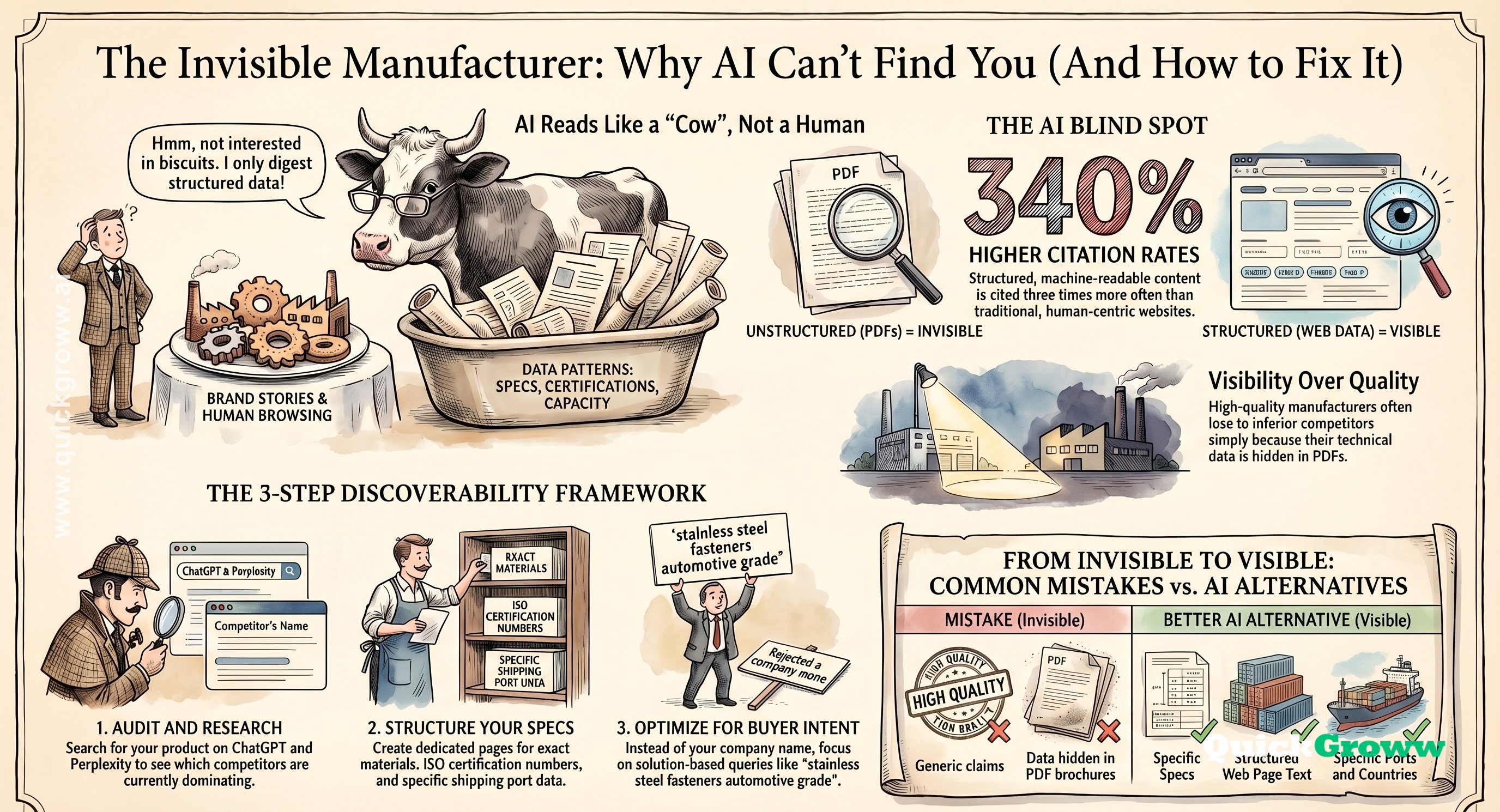
ChatGPT, Perplexity, Gemini, and Grok are like that cow. They don't read your website the way humans do. They scan for specific data patterns. Most business websites are optimized for human readers, not AI interpretation.
Your beautiful homepage with the CEO's photo and company history? AI platforms skip it. Your detailed "About Us" page? Ignored. That contact form buried three clicks deep? Never found.
AI platforms look for structured information: product specifications, certifications, capacity data, geographic coverage, industry applications. If this information isn't formatted correctly, you're invisible.
Companies with structured AI-readable content see 340% higher citation rates than traditional websites. The difference isn't content quality. It's content structure.
Step 1: Audit Your Current AI Visibility
Open ChatGPT right now. Type your main product and your country. See what happens.
For Brazilian automotive components, I tested these queries:
- "brake disc manufacturers Brazil"
- "automotive parts suppliers São Paulo"
- "transmission components exporters Brazil"
Same pattern every time. International competitors appear. Chinese suppliers dominate. European companies get mentioned. Brazilian manufacturers — even excellent ones — stay invisible.
Now test Perplexity with the same queries. Then Gemini. Then Grok. Document which competitors appear consistently. This is your competitive reality.
I did this exercise with a transmission parts manufacturer in Curitiba. Five different AI platforms, ten different queries. His company appeared once. His main competitor appeared in 8 out of 10 responses.
"How is that possible?" he asked. "Our quality is better."
Quality doesn't matter if AI platforms can't see it.
Step 2: Create AI-Readable Product Information
Traditional websites organize information for human browsing. AI platforms need structured data they can extract and cite.
Here's the framework that works:
Product Specifications Sheet: Create dedicated pages for each major product line. Include exact specifications, materials, certifications, applications, and capacity data. For automotive components, specify vehicle compatibility, performance standards, and testing certifications.
Geographic Coverage Data: List exact countries, ports, shipping capabilities, and local partnerships. Don't say "worldwide shipping." Say "regular shipments to Mexico, Argentina, Colombia, and Chile via Santos Port."
Certification Documentation: List ISO certifications, quality standards, testing protocols, and compliance documentation with specific numbers and renewal dates.
Production Capacity Information: Specify monthly production volumes, lead times, minimum order quantities, and seasonal capacity variations.
A pharmaceutical equipment manufacturer in Mumbai restructured their content this way. Within 45 days, they went from zero AI citations to appearing in 7 out of 10 ChatGPT queries for their product category.
Step 3: Optimize for Buyer Question Patterns
Buyers don't search for your company name. They search for solutions to problems.
Instead of optimizing for "ABC Manufacturing," optimize for:
- "stainless steel fasteners automotive grade"
- "pharmaceutical tablet coating equipment"
- "organic spice suppliers bulk export"
- "textile dyeing machinery energy efficient"
I spent two decades listening to buyer questions. The patterns are predictable. Buyers ask about specifications first, certifications second, pricing third. Structure your content to answer these questions in order.
For Brazilian automotive components targeting Mexican buyers, the questions are:
- What NAFTA compliance certifications do you have?
- What's your monthly production capacity?
- Which automotive OEMs do you currently supply?
- What are your lead times to Mexico?
Your AI Export Sales Agent needs to answer these questions before buyers ask them.
Step 4: Build Competitive Intelligence
Your competitors who appear on AI platforms aren't smarter. They're just more visible.
Study their content structure. How do they format product specifications? What certifications do they highlight? How do they describe their geographic coverage?
A cotton yarn exporter in Gujarat noticed that European competitors always mentioned specific cotton origins, fiber lengths, and yarn counts. Indian manufacturers talked about quality and relationships. AI platforms cited the Europeans because they had extractable data.
Copy the structure, not the content. If competitors list "Production Capacity: 500 tons monthly," format your information the same way: "Production Capacity: 750 tons monthly."
Step 5: Measure and Iterate
AI visibility isn't a one-time project. It's an ongoing optimization process.
Track these metrics monthly:
- Citation frequency across ChatGPT, Perplexity, Gemini, and Grok
- Position in AI responses (first mentioned vs. third mentioned)
- Competitor citation frequency for comparison
- Query coverage (appearing for primary vs. secondary product terms)
Set up a systematic testing schedule. First Monday of each month, test 20 queries across four platforms. Document the results. Track improvements.
Common Mistakes That Kill AI Visibility
Mistake 1: Generic Content: Writing "high quality products" instead of specific technical specifications.
Mistake 2: Hidden Information: Putting key data in PDF brochures instead of web pages that AI can read.
Mistake 3: Human-Only Formatting: Beautiful layouts that AI platforms can't interpret.
Mistake 4: Inconsistent Updates: Launching content once and never maintaining it.
Mistake 5: Single Platform Focus: Optimizing for Google while ignoring ChatGPT, Perplexity, and Gemini.
I've seen surgical instrument exporters in Pakistan make every one of these mistakes. Great products, excellent manufacturing, zero AI visibility.
The Reality Check
Here's what I learned after building 343 API endpoints and 227,000 lines of code for QuickGroww: AI visibility is complex, but the principles are simple.
Buyers are already using ChatGPT, Perplexity, Gemini, and Grok to research suppliers. If your company doesn't appear in their results, you don't exist in their decision process.
Your competitors who appear aren't necessarily better manufacturers. They just understand how AI platforms work.
The gap is widening every month. AI citation patterns reinforce over time. Early movers get locked in. Latecomers struggle to displace them.
Frequently Asked Questions
Q: How long does it take to see results from AI optimization?
A: Companies with structured AI-readable content typically see initial citations within 30-45 days, with full optimization taking 60-90 days depending on content depth and competitive landscape.
Q: Do I need to hire technical experts to implement this framework?
A: The framework requires content restructuring and systematic testing, but doesn't require coding skills. Most manufacturers can implement the basic structure using existing website tools.
Q: Which AI platform should I prioritize first?
A: Start with ChatGPT since it has the largest user base, but test all four platforms (ChatGPT, Perplexity, Gemini, Grok) since buyers use different tools for research.
Q: How often should I test my AI visibility?
A: Monthly systematic testing across 20 queries and four platforms provides reliable tracking data without consuming excessive time.
Q: What if my competitors are already dominating AI search results?
A: Competitor dominance reflects better content structure, not better products. The framework works regardless of current competitive positioning, though it may take longer to displace established citations.