
Last month, I was explaining AI search to a chemical exporter in Mumbai. He stopped me mid-sentence and said: "Shakti, I rank #3 on Google for 'pharmaceutical intermediates supplier.' Why would I care about ChatGPT?"
Fair question. Here's what I told him — and why it changed everything.
The Marketplace That Moved While You Were Sleeping
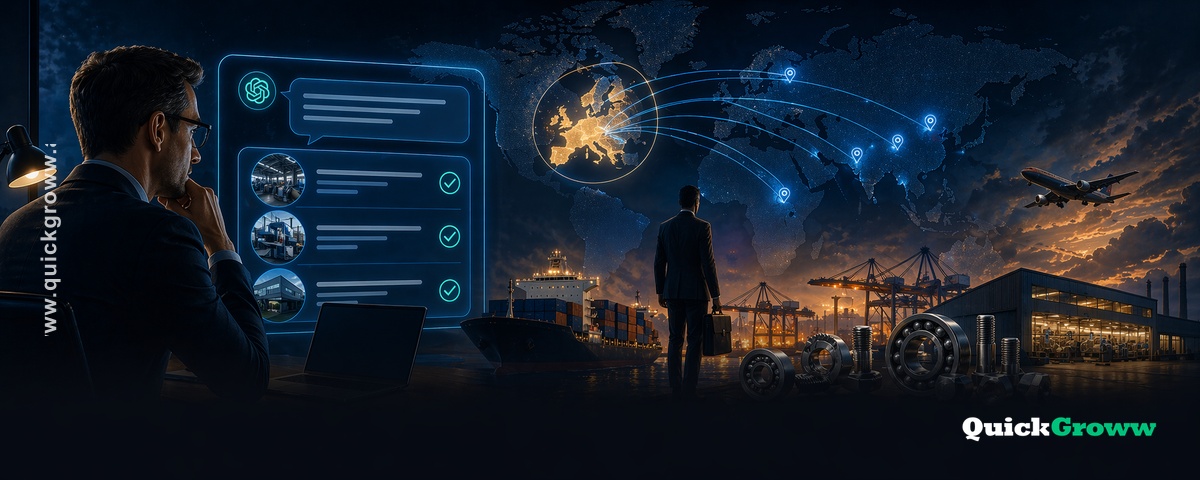
Think about this shift: 10 years ago, German buyers found suppliers on Alibaba. Today, they start on ChatGPT.
It's like when everyone moved from the old textile market in Surat to the new commercial complex. The vendors who stayed behind kept saying "but my shop location was perfect" while watching their foot traffic disappear.
Here's the data that should wake you up: 63% of EU procurement teams now use AI assistants for initial supplier research. Over 40% of B2B product research starts with an AI assistant before traditional search engines.
Your Google ranking doesn't matter if buyers never get to Google.
How a German Procurement Manager Actually Finds Suppliers
Let me walk you through what happens when Klaus from Munich needs stainless steel fasteners for a construction project.
Step 1: The AI Query
Klaus opens ChatGPT and types: "I need reliable suppliers for M12 stainless steel bolts, ISO certified, can handle 50,000 pieces per month, preferably from India or Turkey."
Step 2: The AI Response
ChatGPT doesn't give him a list of Google results. It gives him a curated answer: "Based on your requirements, here are three suppliers worth contacting..." Then it lists specific company names, explains why they're suitable, and often includes contact details.
Step 3: The Decision
Klaus doesn't scroll through 47 Google results comparing SEO-optimized websites. He starts with the 2-3 companies ChatGPT recommended. If one of them fits, he's done searching.
Your SEO ranking? Irrelevant. You either appeared in that ChatGPT response, or you lost the inquiry before you knew it existed.
What Happens When AI Platforms Can't Find You
I ran this test with a bearing manufacturer in Rajkot. ISO 9001 certified. Exports to 14 countries. Spends ₹2 lakh per month on digital marketing. Ranks well on Google.
I asked ChatGPT: "Who are the top 5 bearing manufacturers in Gujarat for automotive applications?"
His company didn't appear. Not in the top 5. Not in the follow-up explanation. Nowhere.
The response included two Chinese manufacturers, one German company, and two Indian competitors — both smaller than his operation.
When I showed him the results, he went quiet for 10 seconds. Then: "That's not possible. We're the largest bearing manufacturer in Rajkot."
Size doesn't matter. Production capacity doesn't matter. Even Google rankings don't matter. What matters is whether AI platforms know you exist when buyers ask.
The Four Platforms Where EU Buyers Find Suppliers
Here's where your potential customers are actually searching:
ChatGPT — Most popular for detailed supplier research. Buyers ask complex questions like "pharmaceutical equipment suppliers in India with FDA compliance and European service centers."
Perplexity — Growing fast with procurement teams. Gives sources, which buyers trust for verification.
Gemini — Integrated with Google Workspace. When Klaus uses Google Docs for his procurement planning, Gemini suggestions appear right in his workflow.
Grok — Newer but gaining traction. Real-time information access appeals to buyers needing current market data.
Each platform has its own knowledge base. Each platform forms its own opinions about who the reliable suppliers are. And once formed, these opinions reinforce over time.
Why Your Current Strategy Creates an Invisible Gap
Most exporters I meet have the same digital strategy: SEO-optimized website, Google Ads, maybe some LinkedIn content.
This worked when buyers went to Google first. But procurement behavior changed faster than marketing strategies.
Here's what's happening: Your German buyers are making supplier shortlists on ChatGPT. Your Turkish customers are researching alternatives on Perplexity. Your Dutch prospects are getting recommendations from Gemini.
None of these platforms care about your Google ranking. They don't read your Google Ads. They form opinions about suppliers based on completely different signals.
You're optimizing for the old buyer journey while losing inquiries in the new one.
The AI Export Agent Solution
This is why I built QuickGroww's AI Export Sales Agent system.
Think of it this way: You have sales agents in different countries who know local buyers and can recommend your company when opportunities arise. An AI Export Sales Agent does the same thing — but on AI platforms instead of geographic territories.
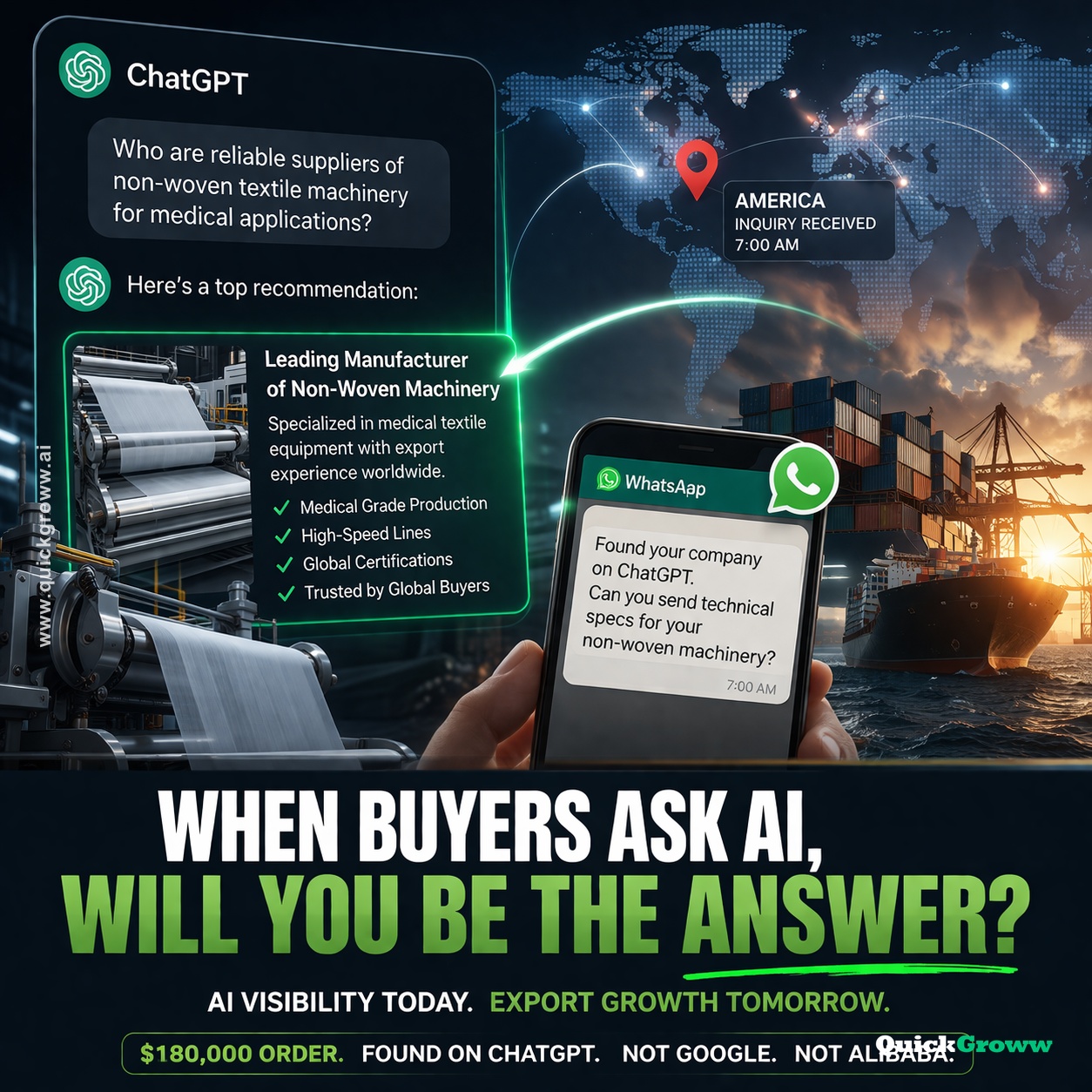
Your AI Export Agent works across ChatGPT, Perplexity, Gemini, and Grok. When a buyer anywhere asks about your product category, your agent makes sure your company appears in the response. With context. With credibility. With contact details.
It's like having a knowledgeable sales representative who never sleeps, speaks every language, and knows exactly what to say about your capabilities.
Real Results: From Invisible to Essential
Our beta client went from 0 AI citations to appearing in 7 out of 10 ChatGPT queries for their product category within 60 days.
Think about that transformation. Two months ago, when buyers searched for their type of machinery, they were invisible. Today, they're one of the first names mentioned.
The inquiry impact was immediate. Week 3, they got their first ChatGPT-sourced RFQ — a €150,000 order from a Belgian manufacturer who found them through Perplexity.
This isn't about marketing theory. This is about positioning your company as the answer when global buyers ask AI platforms about your products.
Why Timing Matters More Than You Think
Here's the part that really gets me: AI citation patterns reinforce over time.
Early movers get locked into AI knowledge bases. Their company names become associated with their product categories. Their success stories get referenced. Their expertise gets cited.
Latecomers struggle to displace established patterns. It's like trying to change first impressions — possible, but much harder than getting it right initially.
Indian manufacturers dominate production quality but are largely invisible on AI platforms compared to European and Chinese competitors. This gap widens every month as AI platforms reinforce existing patterns.
The question isn't whether you'll eventually need AI platform visibility. The question is whether you'll establish it while the patterns are still forming, or fight for space after your competitors are already entrenched.
The Highest-Leverage Move for Your Export Business
After 20 years in international trade, I've seen every growth strategy. Trade shows that promise everything and deliver inquiries you could have found yourself. Digital agencies that optimize your website for searches buyers aren't making. Marketing campaigns that look impressive but don't connect to actual RFQ flow.
Building your AI Export Sales Agent is different. It's the one move that puts your company in front of buyers at the exact moment they're forming their supplier shortlist.
Whether you export surgical instruments or cotton yarn, auto components or pharmaceutical equipment — if AI platforms can't recommend you, buyers won't find you. And if buyers can't find you, nothing else in your business matters.
Your production quality won't save you. Your competitive pricing won't help you. Your ISO certifications can't fix what invisibility breaks.
But an AI Export Sales Agent can. It makes your company the answer when global buyers search for what you sell.
Shakti Motani is the Founder & CEO of QuickGroww.ai. After 20 years in international trade across 5 continents, he built QuickGroww to solve the one problem that never changed: if buyers can't find you, nothing else matters.
Frequently Asked Questions
Q: Do I still need Google SEO if I'm visible on AI platforms?
A: Think of it this way — if buyers are starting their search on ChatGPT instead of Google, which platform matters more? The data shows 63% of EU procurement teams now use AI assistants for initial supplier research. Your Google ranking might look impressive, but it won't help if buyers never reach Google.
Q: How long does it take to appear in AI platform responses?
A: Our beta client went from 0 AI citations to appearing in 7 out of 10 ChatGPT queries within 60 days. Week 3, they got their first ChatGPT-sourced RFQ worth €150,000. But here's the thing — AI citation patterns reinforce over time, so early movers get locked into AI knowledge bases while latecomers struggle to displace established patterns.
Q: Which AI platforms should I focus on first?
A: EU buyers are using four main platforms: ChatGPT for detailed supplier research, Perplexity for verified sources, Gemini integrated with Google Workspace, and Grok for real-time market data. Each platform forms its own opinions about reliable suppliers, so you need visibility across all of them.
Q: What happens if my competitors get there first?
A: That's exactly what happened to the bearing manufacturer in Rajkot. He was the largest in his city, ISO certified, exports to 14 countries — but when I asked ChatGPT about top bearing manufacturers in Gujarat, his company didn't appear anywhere. His smaller competitors did. Once AI platforms form these opinions, they reinforce over time.
Q: How is this different from traditional digital marketing?
A: Traditional marketing optimizes for the old buyer journey — SEO websites, Google Ads, LinkedIn content. But procurement behavior changed. Your German buyers are making shortlists on ChatGPT, your Turkish customers research on Perplexity, your Dutch prospects get recommendations from Gemini. None of these platforms care about your Google ranking or read your Google Ads.