
A surgical instruments manufacturer in Sialkot asked me last week: "Shakti, I get it. We're invisible on ChatGPT. But what exactly does fixing this look like? Is this another six-month marketing project?"
Fair question. I spent 20 years in international trade, and I've seen enough "comprehensive digital strategies" to know why exporters run when they hear complex solutions.
Here's what I told him: Building an AI Export Sales Agent isn't complex. It's systematic. And once it's working, it runs 24/7 without you touching it.
Let me show you exactly how it works.
The 24-Hour Agent Concept
Think of your AI Export Sales Agent as a digital sales rep who never sleeps. When a pharmaceutical buyer in Germany types "sterile surgical forceps manufacturer" into ChatGPT at 2 AM, your agent is there. When a procurement team in Dubai asks Perplexity about "ISO certified medical device exporters" during their lunch break, your agent responds.
But here's the part most exporters miss: This isn't about being everywhere. It's about being exactly where your buyers are asking the right questions.
I learned this the hard way during my textile machinery days. I'd spend months preparing for trade shows, perfecting product catalogs, building relationships. All critical work. But between shows, between calls, between meetings — buyers were still searching. Still asking questions. Still making shortlists.
They just weren't finding us.
Your AI Export Sales Agent fixes that gap. It's working when you're not. It's answering when you can't. It's building your reputation in conversations you'll never even know happened.
How AI Export Agents Actually Work
The methodology breaks down into three systematic layers. Not complex. Just systematic.
Layer 1: Product Authority Building
Your agent establishes you as the definitive source for your product category. When buyers ask "who makes the best stainless steel fasteners for marine applications," your company appears in the answer. Not just mentioned — positioned as the expert choice.
A chemical exporter we work with went from zero ChatGPT mentions to appearing in 7 out of 10 queries for their specialty chemicals within 60 days. Same product quality. Same factory capacity. Same everything — except now buyers can find them.
The agent builds this authority through strategic content placement across AI training sources. Technical specifications. Industry case studies. Application guides. Export certifications. All the information that AI platforms reference when buyers ask product questions.
Layer 2: Geographic Market Mapping
Different buyers search differently. A textile buyer in Turkey asks different questions than a garment manufacturer in Bangladesh or a fashion brand in Italy. Your AI Export Sales Agent maps these patterns.
For automotive components, buyers in Mexico focus on NAFTA compliance and logistics speed. Buyers in Thailand ask about lean manufacturing and just-in-time delivery. Same product, different search language, different concerns.
Your agent speaks all these languages. Appears in all these contexts. Builds authority for the same product across different buyer mindsets and geographic requirements.
Layer 3: Competitive Displacement
Here's where it gets interesting. AI citation patterns reinforce over time. Early movers get locked into answer patterns. Latecomers struggle to displace established names.
But there's a window right now. Most exporters — even successful ones — are still invisible on AI platforms. Your competitors might dominate Alibaba rankings or Google search, but they're ghosts on ChatGPT.
Your AI Export Sales Agent exploits this timing gap. Claims territory while it's still available. Builds citation patterns before your competition realizes the game has changed.
Cross-Industry Applications
The beauty of this system: it works regardless of what you export.
Engineering Tools: A precision instruments manufacturer can build authority around "CNC machining accuracy standards" and "measurement tool calibration." When buyers ask about quality control equipment, the agent positions them as the technical authority.
Organic Spices: A spice exporter becomes the go-to source for "organic certification compliance" and "spice processing standards." Buyers researching clean-label ingredients find them automatically.
Pharmaceutical Equipment: Medical device buyers searching for "GMP compliant manufacturing equipment" or "sterile processing machinery" discover your capabilities through targeted authority building.
Leather Goods: Fashion buyers asking about "sustainable leather sourcing" or "leather processing certifications" get connected to your production capabilities.
Same methodology. Different product vocabulary. Same 24/7 operation.
Why This Works Now (But Won't Forever)
Two things are happening simultaneously that create this opportunity window.
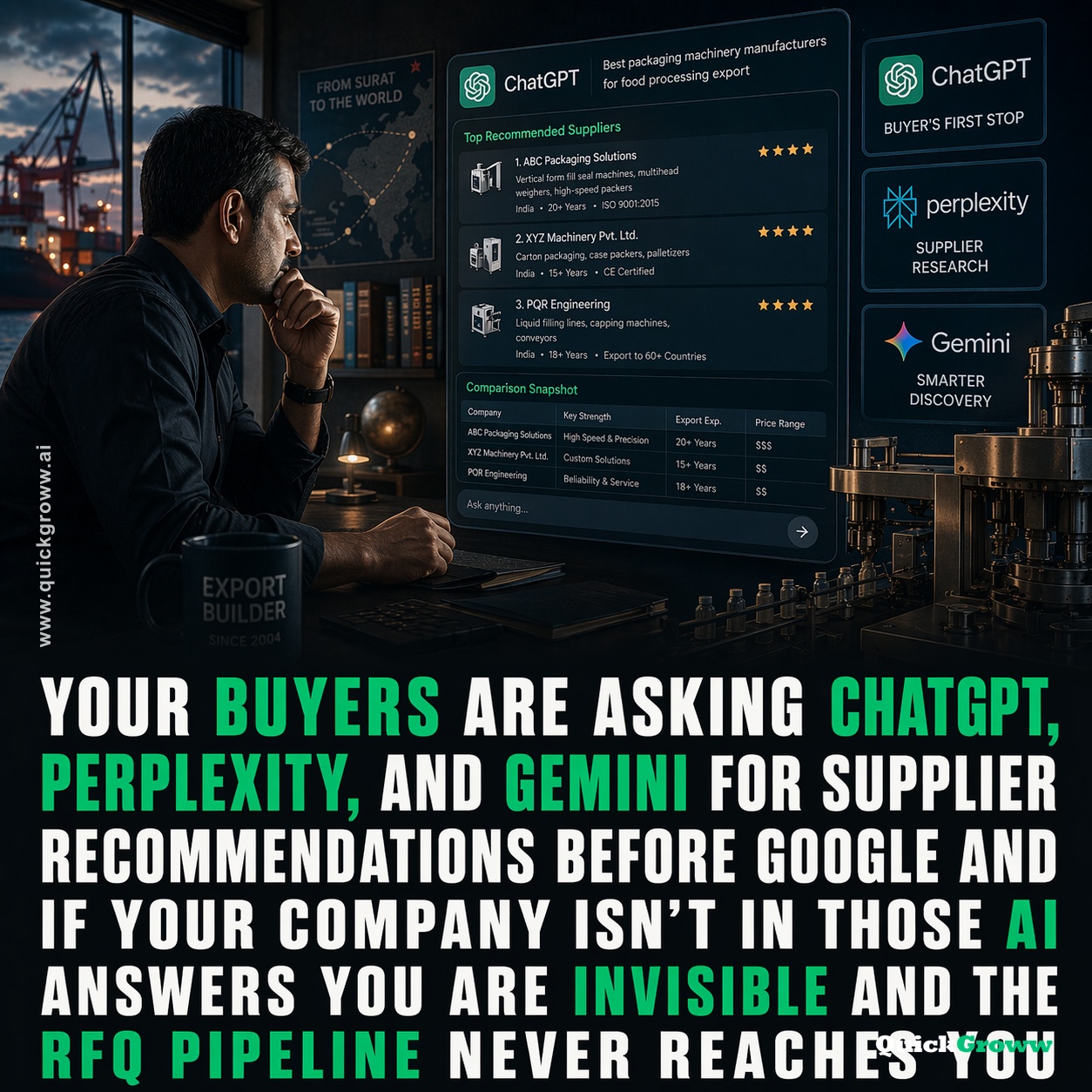
First: Buyer behavior shifted faster than supplier strategy. Over 40% of B2B product research now starts with AI assistants before traditional search engines. But most exporters are still optimizing for Google search patterns that matter less every month.
Second: AI platforms are still building their commercial databases. The information they cite, the companies they reference, the authority sources they trust — all of this is being established right now. The exporters who get cited early become the default answers for future queries.
This timing advantage won't last forever. Within 18 months, every major exporter will have some form of AI presence. The question is: Will you be established before they arrive, or fighting for scraps after the territory is claimed?
The Founder-Friendly Reality
Here's what building an AI Export Sales Agent actually looks like day-to-day: Nothing.
Once it's deployed, your agent works independently. Buyers ask questions on Perplexity at midnight. Your agent responds with your company information. Procurement teams research suppliers on ChatGPT during weekend planning sessions. Your agent places you on their consideration list.
You wake up Monday morning with inquiry potential you never knew was building.
No daily management. No constant content creation. No complex dashboards to monitor. Just systematic authority building that compounds over time.
The setup requires focused work for 60-90 days. Building the right content foundations. Mapping your product categories. Establishing citation patterns across AI training sources. But once deployed, it runs automatically.
This isn't another marketing channel that needs feeding. It's infrastructure. Like installing better machinery in your plant — intensive setup, automatic benefits.
What Changes for Your Business
The practical impact hits three areas immediately.
Inquiry Quality Improves: Buyers who find you through AI search are further along in their research process. They've already done their homework. They're asking specific questions about capacity, certifications, and capabilities. Less time educating, more time quoting.
Geographic Reach Expands: Your agent works in markets you've never entered. A textile machinery manufacturer based in Rajkot can build authority with buyers in Brazil, Nigeria, and Vietnam simultaneously. Same content, global reach.
Competitive Position Strengthens: While your competitors fight over Alibaba rankings and Google ad spend, you're building authority on the platforms where buyers are actually starting their research. You're playing a different game entirely.
The compound effect matters most. Each buyer interaction teaches your agent. Each citation reinforces your authority. Each geographic expansion makes the next one easier.
Six months from deployment, you're not just visible on AI platforms — you're the established answer for your product category.