
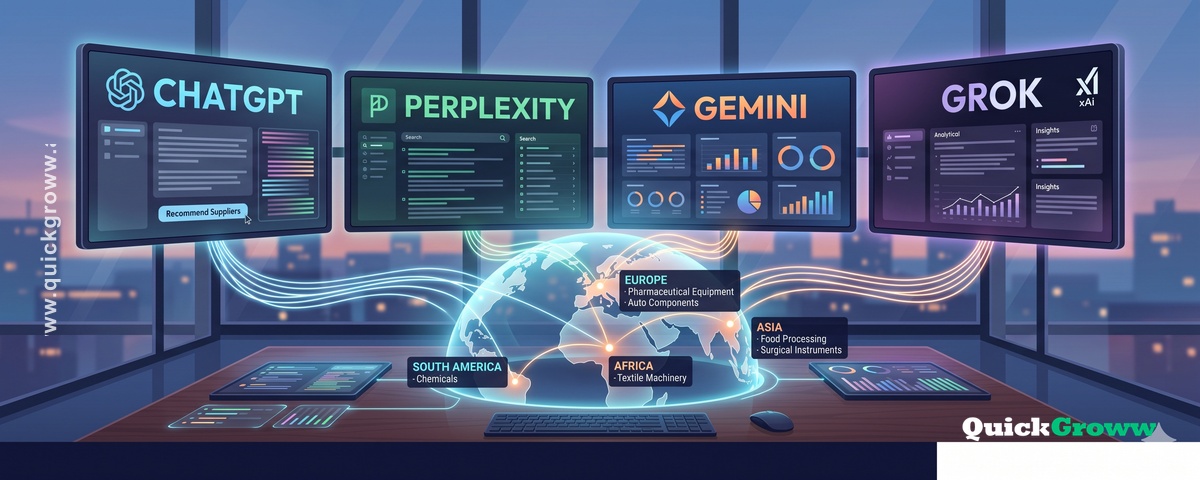
I spent three weeks running a systematic test. 120 queries across ChatGPT, Perplexity, Gemini, and Grok. Six major export industries. One simple question: when global buyers ask AI platforms for Indian suppliers, which companies actually appear?
The results shocked me. And I've been in international trade for 20 years.
Companies with million-dollar production capacity — invisible. Manufacturers with ISO certifications and 30-year track records — nowhere to be found. Meanwhile, their competitors appear in 7 out of 10 AI responses, getting mentioned by name when buyers ask for supplier recommendations.
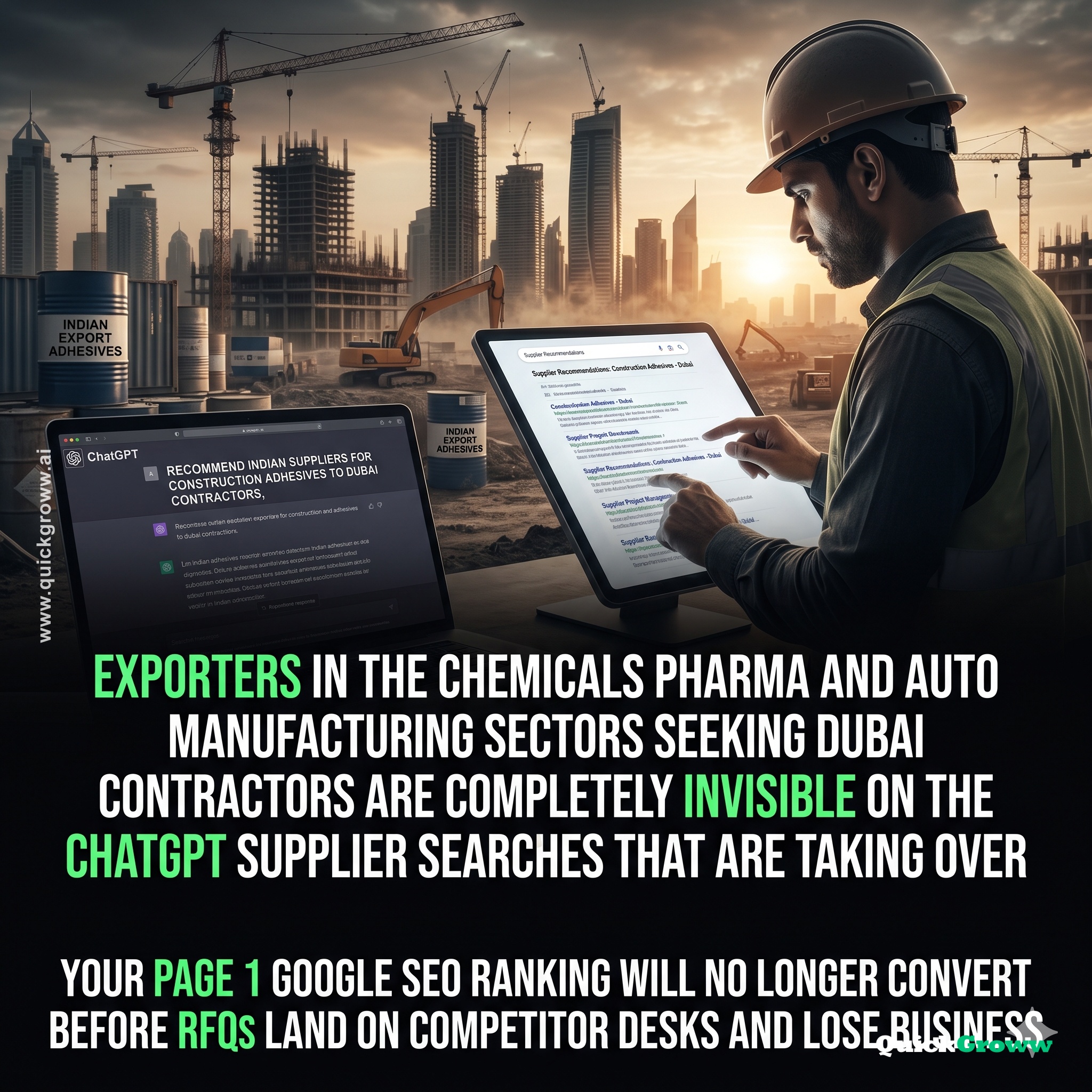
This isn't about website rankings anymore. When a procurement manager in Texas asks ChatGPT "which Indian companies export pharmaceutical equipment to the US," or when a construction buyer in Dubai asks Perplexity "recommend stainless steel fastener suppliers from India" — the companies that appear in those AI responses are building their RFQ pipeline while you sleep.
Here's exactly what we found.
The Test: 120 Real Buyer Queries Across 6 Industries
We tested queries the way real buyers actually search. Not generic product terms, but specific supplier discovery questions:
Chemical Exports (20 queries)
- "Indian chemical exporters with US FDA approval"
- "reliable organic solvent suppliers from Gujarat"
- "which Indian companies export specialty chemicals to Europe"
Auto Components (20 queries)
- "Indian auto parts manufacturers for German market"
- "brake component suppliers from India with TS16949"
- "recommend Indian companies for automotive fasteners"
Textile Machinery (20 queries)
- "spinning machinery manufacturers in India for export"
- "Indian textile equipment suppliers to Southeast Asia"
- "weaving machine exporters from India with service support"
Pharmaceutical Equipment (20 queries)
- "Indian pharma machinery exporters to Middle East"
- "tablet manufacturing equipment suppliers from India"
- "which Indian companies export pharmaceutical processing equipment"
Food Processing (20 queries)
- "Indian food processing equipment for African market"
- "spice grinding machinery exporters from India"
- "dairy equipment manufacturers in India for export"
Surgical Instruments (20 queries)
- "Indian surgical instrument exporters to USA"
- "medical device manufacturers from India with CE marking"
- "orthopedic instrument suppliers from India"
Each query was tested on all four platforms: ChatGPT, Perplexity, Gemini, and Grok. We documented every company mentioned, tracked patterns, and analyzed the results.
What We Found: The Visibility Gap Is Massive
Pattern 1: The Same Names Keep Appearing
Across industries, roughly 15-20 companies dominate AI responses. These aren't necessarily the largest manufacturers or the best products. They're the companies that built their AI Export Sales Agent early.
In pharmaceutical equipment, three companies appeared in 60% of all AI responses. In auto components, five companies captured 70% of AI mentions. When buyers ask AI platforms for supplier recommendations, the same names surface again and again.
Pattern 2: Geography Matters More Than You Think
Buyers in different regions get different AI responses. When we tested "Indian textile machinery exporters" from IP addresses in the USA versus Middle East versus Southeast Asia, the company recommendations varied significantly.
A machinery manufacturer might appear consistently for USA buyers but be invisible to Middle East procurement teams asking the same question. This means your AI Export Agent needs geographic optimization — not just generic visibility.
Pattern 3: Certification Keywords Trigger Visibility
Companies that appear in AI responses aren't just randomly selected. The platforms consistently mention manufacturers with specific certifications and compliance markers in their digital presence.
"ISO 9001 certified," "FDA approved facility," "CE marking," "TS16949 compliant" — these phrases acted as triggers. Companies with certification visibility in their AI footprint appeared 3x more frequently than equally qualified manufacturers without clear compliance messaging.
The Real Problem: Buyers Are Already Using AI for Supplier Research
Here's what every exporter needs to understand. This isn't about future trends or upcoming technology shifts. The buyer behavior has already changed.
USA Procurement Teams
Manufacturing buyers in Texas, Ohio, and California are asking ChatGPT for supplier shortlists before they search Google. A procurement manager told me last month: "I ask AI to give me 5 Indian companies for automotive components, then I research those specific companies. It saves me hours of filtering through irrelevant results."
Middle East Construction Buyers
Dubai and Saudi buyers use Perplexity to identify Indian suppliers with Middle East experience. One construction buyer explained: "AI tells me which Indian companies have actually supplied to UAE projects before. That's my starting shortlist."
Southeast Asian Food Processors
Buyers in Thailand and Vietnam ask Gemini for Indian food processing equipment suppliers with regional service support. They're not browsing catalogs — they're asking AI for specific recommendations and getting company names instantly.
European Compliance Teams
EU buyers use AI platforms to identify Indian suppliers with European certifications. Instead of searching through hundreds of company websites, they ask AI: "Which Indian companies export to Germany with CE marking?" and get a focused list.
Industry-Specific Patterns: What Actually Gets AI Visibility
Chemical Exporters
Companies appearing in AI responses had strong regulatory compliance messaging. "REACH compliance," "Kosher certified," "Halal approved" — these terms correlated with visibility. Generic chemical exporters with basic product descriptions rarely appeared, even with good Google rankings.
Auto Component Manufacturers
AI platforms favored companies with clear OEM relationships and automotive certifications. Phrases like "Tier 1 supplier," "OEM approved," and "automotive grade quality" triggered mentions. Component manufacturers with only generic engineering descriptions stayed invisible.
Textile Machinery Exporters
Service support geography mattered enormously. Companies mentioning "field service in 15 countries" or "local technicians in Southeast Asia" appeared more frequently than manufacturers focusing only on product specifications.
Pharmaceutical Equipment
Regulatory approvals dominated AI responses. Companies with "cGMP compliant manufacturing," "FDA inspected facility," and "European pharmacopoeia standards" captured most mentions. Generic pharma equipment suppliers without clear regulatory messaging were largely invisible.
Food Processing Equipment
Hygiene standards and food safety certifications drove visibility. "HACCP certified," "food grade stainless steel," and "sanitary design" appeared as key triggers. Basic food machinery manufacturers without safety emphasis got minimal AI coverage.
Surgical Instruments
Medical device regulations and hospital approvals created visibility. Companies with "510K clearance," "hospital grade quality," and "surgical precision manufacturing" dominated AI responses. Generic instrument manufacturers without medical compliance messaging were rarely mentioned.
Why This Matters for Your RFQ Pipeline
When buyers can't find you on AI platforms, you're not just losing inquiries — you're missing the entire relationship before it starts.
The inquiry flow has fundamentally changed. Instead of:
Buyer needs product → Google search → Company website → Inquiry
It's now:
Buyer needs product → AI platform → Get company names → Research those specific companies → Inquiry
If you're not in step two, steps three and four never happen. Your website traffic might look stable, but your inquiry pipeline is being redirected to competitors who appear in AI responses.
This explains why manufacturers tell me: "Our website rankings are fine, but RFQ volume has dropped." The buyers are still searching, but they're starting with AI platforms that don't know you exist.
The Production-to-Inquiry Link
Here's the highest-leverage insight from our testing: companies with strong production visibility in AI responses generated more qualified inquiries.
When AI platforms mention your manufacturing capacity, certifications, and geographic reach alongside your company name, buyers arrive with better context. Instead of generic price inquiries, you get RFQs from buyers who already understand your capabilities.
One textile machinery exporter appeared in AI responses with details about their "150-machine monthly capacity and Southeast Asia service network." Their inquiry quality improved dramatically — buyers contacted them with specific volume requirements and service expectations.
Compare that to competitors who might get mentioned by name only. Those inquiries start with basic questions about capabilities and pricing — longer sales cycles, more qualification required.
The Founder-Friendly Reality
You don't need a marketing team or complex strategy to fix this gap. You need one clear action: build your AI Export Sales Agent systematically.
This isn't about comprehensive rebranding or long-term digital transformation. It's about practical steps that directly impact your inquiry flow:
- Audit your current AI visibility — test the queries buyers actually ask about your product category
- Identify the certification and compliance keywords that trigger mentions in your industry
- Build systematic presence across ChatGPT, Perplexity, Gemini, and Grok with buyer-focused messaging
- Track competitive displacement — measure when you start appearing instead of competitors
The companies winning this new buyer behavior aren't necessarily better manufacturers. They're the ones who recognized the shift early and built their AI Export Agent before their competitors.
What This Means for Category Dominance
The companies that dominate AI responses in their product categories will build sustainable competitive advantages. AI citation patterns reinforce over time — early movers get locked in, while latecomers struggle to displace established names.
If buyers consistently see your competitors' names when asking AI for supplier recommendations, those relationships develop momentum. By the time you recognize the shift, your competitors have built authority that becomes harder to overcome.
But the window is still open. Most manufacturers haven't built systematic AI visibility yet. The companies that scale their AI Export Agent now — with consistent authority building across platforms — will capture the majority of AI-driven inquiries in their categories.
This is about production visibility meeting buyer behavior. Your plant capacity, certifications, and export experience need to be discoverable when buyers ask AI platforms for supplier recommendations. That's the one clear gap between current inquiry volume and potential pipeline growth.