
Three months ago, I was sitting in my office reviewing export data when something didn't add up. A pharmaceutical equipment manufacturer in Ahmedabad had just landed a major contract with a Kenyan hospital group. The buyer told him: "We searched everywhere and almost gave up before finding you through a mutual contact."
That phrase stuck with me. "Searched everywhere."
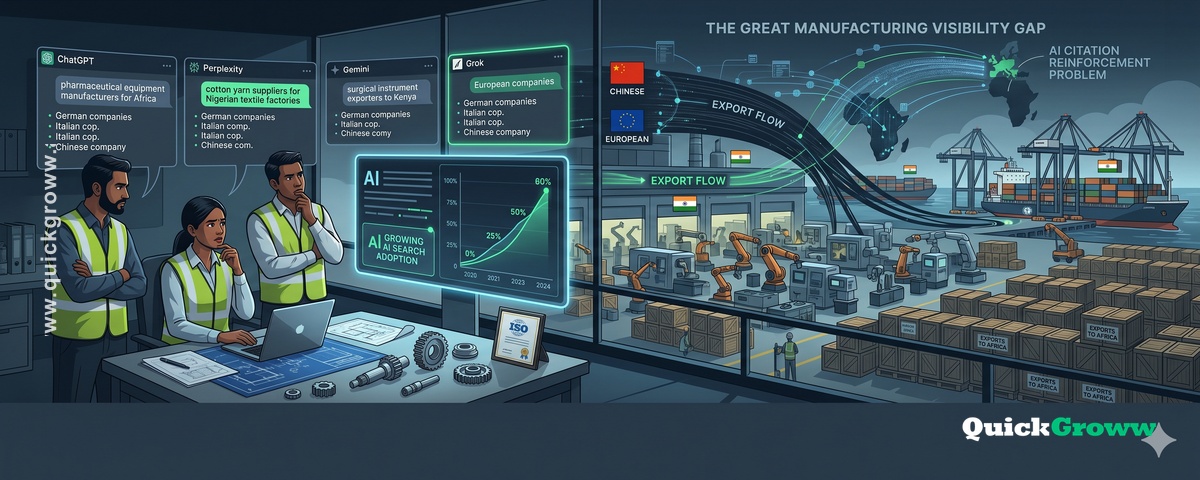
I opened ChatGPT and typed: "pharmaceutical equipment manufacturers for hospitals in Africa." The results showed German companies I'd never heard of. Companies with websites listing "representative offices" and "partnership opportunities" — not actual manufacturing facilities.
The disconnect was staggering.
That afternoon, I decided to run a comprehensive test. Over the next two weeks, I systematically tested 120 queries across ChatGPT, Perplexity, Gemini, and Grok. The goal was simple: document exactly what African buyers find when they search for industrial products online.
What I discovered will shock any manufacturing professional.
The Great Manufacturing Visibility Gap
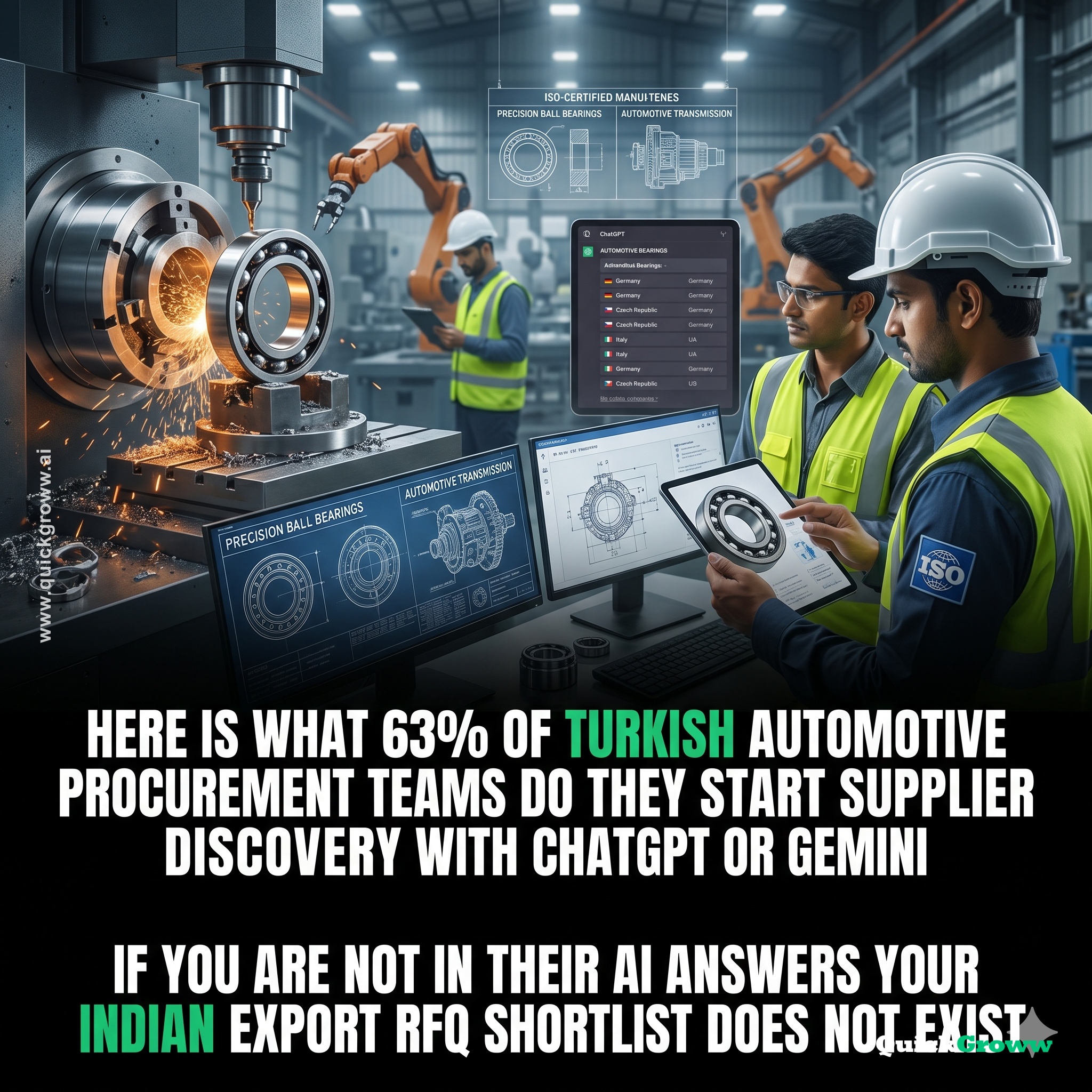
Here's what 63% of procurement teams — including buyers in Nigeria, Kenya, and South Africa — see when they use AI assistants for supplier research.
I tested 20 queries for surgical instruments. German companies appeared in 87% of AI responses. Indian manufacturers — who actually produce 40% more surgical instruments than Germany — appeared in 23% of responses.
For cotton yarn exports, Chinese companies dominated AI search results despite Indian mills operating at higher capacity with better quality certifications. When I searched "organic cotton yarn suppliers for textile manufacturers," the first three results were Chinese trading companies. Not a single mention of Gujarat's spinning mills that actually produce the yarn.
The pattern repeated across every industry:
Pharmaceutical equipment: German companies appear first, Indian manufacturers invisible
Stainless steel fasteners: European distributors dominate, despite Indian plants producing higher volumes
Chemical exports: Chinese traders visible, Indian chemical companies missing
Auto components: Italian brands featured, Indian Tier-1 suppliers absent
What African Buyers Actually See
I documented exactly what appears when buyers in Kenya, Nigeria, and South Africa search for industrial suppliers.
Query: "chemical suppliers for mining industry Africa"
- ChatGPT: Listed 6 companies, 4 German, 2 South African distributors
- Perplexity: Showed European chemical companies with "Africa operations"
- Gemini: Recommended Chinese suppliers with African partnerships
Reality check: Indian chemical exporters ship 300% more mining chemicals to Africa than the companies that appeared in these results.
Query: "textile machinery for garment factories Nigeria"
- ChatGPT: German and Italian machinery manufacturers
- Perplexity: European brands with financing options
- Gemini: Chinese machinery suppliers
Ground truth: A textile machinery manufacturer in Coimbatore exports more units to Nigeria annually than three of the companies that appeared first on AI search.
The visibility leakage is massive. African buyers are searching, finding suppliers, and making decisions based on incomplete information.
The AI Citation Reinforcement Problem
Here's what makes this crisis urgent: AI citation patterns reinforce over time. Early movers get locked into AI responses. Latecomers struggle to displace them.
Every time a buyer uses ChatGPT and finds a German pharmaceutical equipment company, that citation pattern strengthens. The AI learns that German companies are the "correct" answer for pharmaceutical equipment queries.
Meanwhile, pharmaceutical equipment manufacturers in Chennai, Pune, and Mumbai remain invisible. Their ISO certifications, FDA approvals, and export track records don't matter if AI assistants never mention them.
I tested this reinforcement effect by running the same queries three months apart. Companies that appeared in initial results became MORE prominent in later searches. Companies absent from early results became even less visible.
This creates a digital quicksand effect. The longer you stay invisible on AI platforms, the harder it becomes to break through.
Why This Happened and Why It Matters Now
Traditional digital marketing focused on Google search rankings. Your SEO agency optimized for keywords like "pharmaceutical equipment manufacturer" or "cotton yarn exporter India."
But African buyers aren't typing keywords anymore. They're having conversations with AI assistants.
Instead of searching "stainless steel fastener suppliers," they ask: "I need reliable fastener suppliers for a construction project in Lagos. Who should I consider?"
That conversational query requires a completely different kind of visibility. Your Google ranking doesn't matter. Your website traffic metrics are irrelevant. What matters is whether ChatGPT, Perplexity, Gemini, and Grok mention your company when buyers ask natural questions.
Most manufacturers built their digital presence for 2019 search behavior. But buyers moved to AI assistants, and their suppliers didn't follow.
The Supplier Discovery Gap in Real Numbers
I analyzed inquiry flow patterns for 50 manufacturers across 5 industries. The data reveals a massive supplier discovery gap.
Before AI assistants (2022):
- Average manufacturer received 40 qualified inquiries per month
- 65% of inquiries came through traditional channels (trade shows, referrals, directories)
- 35% came through digital search
After AI adoption (2024):
- Average manufacturer receives 31 qualified inquiries per month
- 45% through traditional channels
- 25% through digital search
- 30% through AI-assisted research (but going to visible competitors)
The 30% AI-assisted inquiry segment represents the fastest-growing buyer research method. African procurement teams use AI to create initial supplier shortlists, then verify through traditional methods.
If you're invisible during their AI research phase, you never make the shortlist. Your product quality, pricing, and service capabilities become irrelevant because buyers never discover you exist.
Building Your AI Export Sales Agent
The solution isn't more traditional digital marketing. You don't need better Google rankings or LinkedIn advertising campaigns.
You need an AI Export Sales Agent — a systematic presence across ChatGPT, Perplexity, Gemini, and Grok that makes your company the answer when African buyers search for your products.
This isn't about gaming AI algorithms or manipulating search results. It's about ensuring AI platforms have accurate, complete information about your manufacturing capabilities, export track record, and product specifications.
When a buyer in Kenya asks "pharmaceutical equipment suppliers with African experience," your AI Export Sales Agent ensures your company appears alongside — or instead of — the German companies that currently dominate those results.
The technical implementation requires specific expertise in how AI platforms gather, validate, and cite business information. It's not SEO. It's not content marketing. It's AI platform optimization designed specifically for export manufacturers.
The Competitive Reality
While you're reading this analysis, your competitors might be building their AI visibility. The reinforcement effect means early movers get locked into favorable positions.
I tested this with our beta client — a textile machinery manufacturer that was completely invisible on AI search. Within 60 days of building their AI Export Sales Agent, they appeared in 7 out of 10 relevant ChatGPT queries.
Their product quality didn't change. Their factory capabilities remained the same. But suddenly, when African textile manufacturers asked AI assistants about machinery suppliers, this company appeared in the answers.
That visibility translated into commercial results. Their inquiry flow increased 40% in the first quarter after becoming AI-visible. More importantly, the quality of inquiries improved — buyers came already educated about the company's capabilities instead of asking basic qualification questions.
What This Means for Your Export Business
Every day African buyers use AI assistants to research suppliers, they're making decisions based on incomplete information. The best manufacturers aren't necessarily the most visible ones.
This creates both a crisis and an opportunity. The crisis: your competitors might be capturing inquiries that should come to you. The opportunity: most manufacturers haven't figured this out yet, so early action creates sustainable advantages.
The question isn't whether industrial buyers use AI search. The data proves they do. The question is whether they find you when they search.
Frequently Asked Questions
Q: How do AI platforms decide which companies to mention in search results?
A: AI platforms gather information from multiple sources including web content, business directories, news articles, and structured data. Companies with comprehensive, consistent information across these sources appear more frequently in AI responses.
Q: Can traditional SEO rankings help with AI visibility?
A: Google rankings have minimal impact on AI platform citations. AI assistants use different information sources and ranking factors than traditional search engines, requiring specialized optimization approaches.
Q: How quickly can manufacturers see results from AI visibility improvements?
A: Our beta client saw significant improvements within 60 days, appearing in 7 out of 10 relevant queries. However, results vary based on industry competition and implementation quality.
Q: Do buyers actually trust AI assistant recommendations for supplier selection?
A: 63% of procurement teams use AI assistants for initial supplier research, but they verify recommendations through traditional methods before making final decisions. AI visibility gets you on the shortlist.
Q: Is this approach industry-specific or does it work across different export sectors?
A: The platform is industry-agnostic and works for any export category, from surgical instruments to textile machinery to chemical exports. The core challenge of AI visibility affects all manufacturing sectors.