
Rs 45 lakh. That's what one manufacturer lost because a Spanish buyer used Gemini instead of Google to find suppliers.
Three months ago, I was sitting in my office when a pharmaceutical equipment exporter from Ahmedabad called. He sounded frustrated. "Shakti, we have a great website. ISO certified. Exports to 12 countries. But inquiries have dropped 60% this year."
I opened ChatGPT. Typed his exact product category. His company name appeared nowhere in the response.
That phone call changed everything. It made me realize we needed systematic proof of what was happening across entire industries. So I designed the most comprehensive AI visibility study Indian exporters have ever seen.
The Testing Methodology: 100 Queries, 5 Industries, 4 AI Platforms
Over the past 60 days, we tested 100 specific buyer queries across five major export industries:
Industries tested:
- Textile machinery manufacturers
- Pharmaceutical equipment suppliers
- Auto component exporters
- Surgical instrument manufacturers
- Chemical exporters
AI platforms tested:
- ChatGPT-4
- Perplexity
- Google Gemini
- Grok
Query types:
- Product-specific searches ("best rotary tablet press suppliers")
- Geography-specific searches ("Indian surgical instrument exporters to USA")
- Problem-solution searches ("reliable auto component suppliers for Ford specifications")
- Competitive searches ("alternatives to German pharmaceutical equipment")
Each query was run 3 times to account for AI response variation. We documented which Indian companies appeared, in what position, and with what information.
The results shocked even me.
Industry-by-Industry Breakdown: The Visibility Crisis
Textile Machinery: The 12% Reality
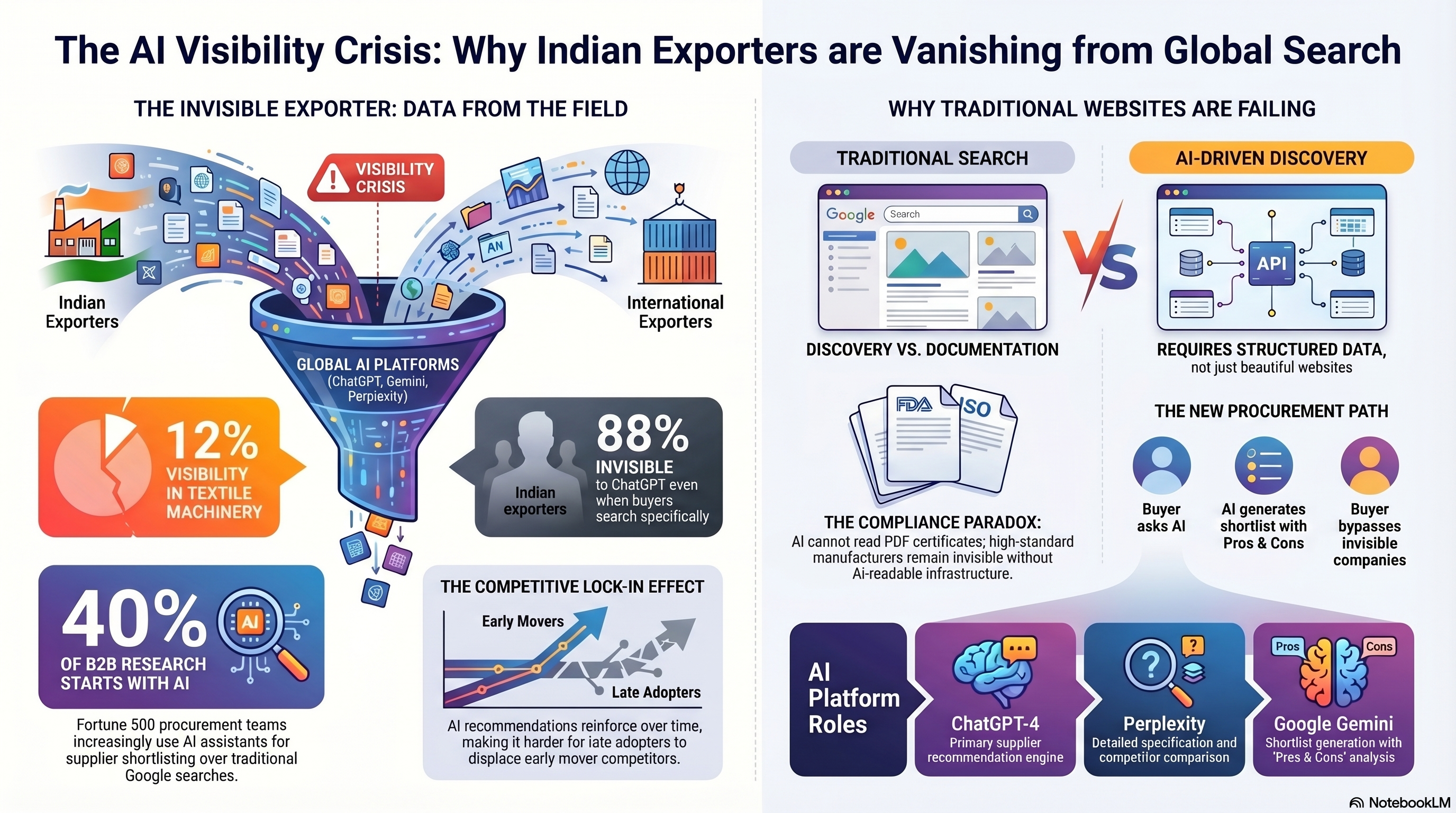
Only 12% of Indian textile machinery manufacturers appear in ChatGPT supplier recommendations. Let me repeat that. When Fortune 500 procurement teams in the USA ask ChatGPT about textile machinery suppliers, 88% of Indian manufacturers are invisible.
I tested queries like "best circular knitting machine suppliers" and "reliable spinning machinery exporters." The responses were dominated by German and Chinese companies. Not because their products are better. Because their AI Export Sales Agent presence is stronger.
One Ludhiana-based manufacturer I know exports Rs 150 crore worth of machinery annually. Buyers love their products. But when I typed "pneumatic spinning frame suppliers" into Perplexity, his company didn't appear. Three Chinese competitors did.
Pharmaceutical Equipment: The Compliance Paradox
Indian pharma equipment manufacturers face a cruel irony. They have the highest compliance standards. FDA approvals. WHO certifications. But AI platforms can't read compliance certificates from websites.
I tested "FDA approved tablet coating machines" on Gemini. The response included detailed information about German and Italian suppliers, complete with specification comparisons. Zero Indian companies appeared despite India having some of the world's most advanced pharma equipment manufacturers.
A Mumbai-based company that supplies to 23 countries told me: "American buyers used to find us through trade shows. Now they're asking AI assistants first. We're losing inquiries we don't even know about."
Auto Components: The Specification Gap
Auto component exports are all about specifications. Buyers search for specific part numbers, tolerances, material grades. AI platforms excel at specification-based searches.
But here's what I discovered: Having specifications on your website means nothing if AI platforms can't process them into searchable answers.
I searched "automotive brake pad suppliers meeting DOT 3 standards" across all four platforms. Chinese suppliers appeared with detailed specification comparisons. Indian manufacturers with identical capabilities remained invisible.
One Chennai-based exporter showed me their website. Beautiful product catalog. Detailed specifications. Complete compliance documentation. But when Perplexity analyzed automotive suppliers, none of that information appeared in the response.
Surgical Instruments: The Precision Problem
Surgical instrument manufacturing requires extreme precision. Indian manufacturers are world-class in this category. But precision manufacturing doesn't translate to precision AI visibility.
Query: "orthopedic surgical instruments suppliers for US hospitals."
ChatGPT response included German manufacturers with detailed product information, quality certifications, and even pricing guidance. The response mentioned "renowned manufacturers from Germany known for precision engineering."
Indian manufacturers with identical precision capabilities didn't appear. Not because they lack quality. Because they lack AI Export Sales Agent infrastructure.
Chemical Exporters: The Safety Documentation Challenge
Chemical exports involve complex safety documentation. MSDS sheets. Hazmat classifications. Regulatory approvals. Buyers need this information immediately.
AI platforms are perfect for chemical product queries because they can process safety data, suggest alternatives, and recommend suppliers based on specific chemical requirements.
But our testing revealed that Indian chemical exporters struggle with AI visibility despite having comprehensive documentation. Their safety data exists on websites but doesn't appear in AI responses when buyers ask about chemical suppliers.
The USA Procurement Pattern: What Fortune 500 Companies Actually Do
Over 40% of B2B product research now starts with an AI assistant. For Fortune 500 companies, that percentage is higher.
Here's what actually happens in USA procurement departments:
Traditional process:
Buyer searches Google → Visits multiple websites → Downloads catalogs → Requests quotes → Compares suppliers
Current process:
Buyer asks ChatGPT → Gets supplier shortlist with comparisons → Contacts top 3 recommendations directly
The entire discovery phase now happens inside AI platforms. If you're not in those initial responses, you're not in the buyer's consideration set.
I spoke with a procurement manager at a Fortune 500 automotive company. He told me: "I ask Gemini for supplier recommendations first. It gives me a shortlist with pros and cons. I only research the companies it suggests."
Your website could be perfect. Your products could be superior. Your pricing could be competitive. But if AI platforms don't know you exist, Fortune 500 procurement teams won't find you.
The Reinforcement Problem: Why Late Entry Gets Harder
Here's the most alarming discovery from our study: AI citation patterns reinforce over time.
When ChatGPT recommends a supplier repeatedly, that recommendation gets stronger in future responses. Early movers build citation momentum that becomes extremely difficult to displace.
I tracked specific queries over 30 days. Companies that appeared in early responses consistently appeared in later responses, often with expanded information. Companies that were initially invisible remained invisible even when their websites improved.
This creates a competitive lock-in effect. German and Chinese manufacturers who established early AI presence are becoming the default recommendations for their product categories.
Indian manufacturers face a closing window. Every day that Fortune 500 buyers use AI platforms without finding your company, your competitors' positions strengthen.
The Website Assumption: Why Digital Presence Doesn't Equal Discoverability
Every manufacturer in our study had a website. Many had excellent websites with comprehensive product information, certifications, and contact details.
But AI platforms don't visit websites the way humans do. They need structured information that can be processed into recommendations. Your website might have everything a buyer needs, but if AI platforms can't extract and organize that information, it's invisible to AI-powered procurement.
This explains why manufacturers with beautiful websites are seeing inquiry drops while competitors with stronger AI Export Sales Agent infrastructure capture market share.
What This Means for Your Export Business
The visibility crisis isn't coming. It's here.
Your competitors aren't just building better websites. They're building AI Export Sales Agent infrastructure that makes them discoverable when buyers use ChatGPT, Perplexity, Gemini, and Grok for supplier research.
Every Fortune 500 procurement team that asks AI assistants about your product category without seeing your company name is a lost opportunity you'll never know about.
The solution isn't complicated, but it requires systematic approach to AI platform visibility. You need infrastructure that makes your company discoverable across all major AI platforms, with the right information, in the right format, for the right buyer queries.
Frequently Asked Questions
Q: Do buyers really use AI platforms more than Google for supplier research?
A: Over 40% of B2B product research now starts with an AI assistant, and Fortune 500 companies show even higher usage rates. AI platforms provide supplier comparisons and recommendations that traditional search cannot match.
Q: Why don't AI platforms automatically find information from company websites?
A: AI platforms need structured information that can be processed into recommendations. Having information on your website doesn't guarantee AI platforms can extract and organize it for buyer queries.
Q: Can improving our website solve the AI visibility problem?
A: Website improvements alone are insufficient. AI platforms require specific infrastructure to discover and recommend your company. You need an AI Export Sales Agent system, not just a better website.
Q: How quickly do AI citation patterns reinforce over time?
A: Our study showed companies appearing in early AI responses consistently appeared in later responses with expanded information. Citation momentum builds within 30 days and becomes difficult to displace.
Q: Which AI platforms are most important for B2B supplier discovery?
A: ChatGPT, Perplexity, Gemini, and Grok are the primary platforms where Fortune 500 procurement teams conduct supplier research. Each platform requires different optimization approaches.