
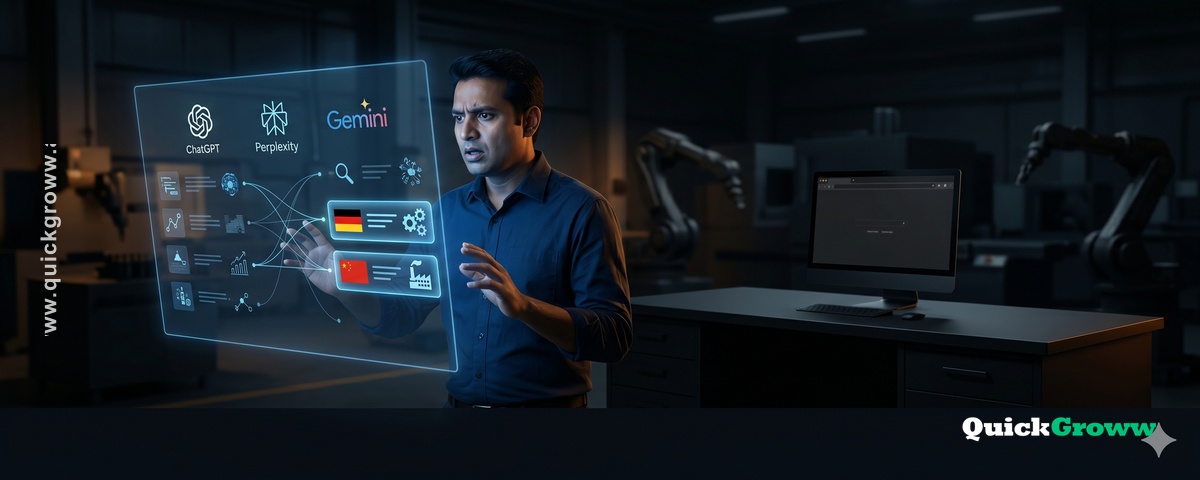
Last month, something happened in our office that I can't stop thinking about.
My colleague was helping a surgical instruments manufacturer from Jalandhar — ISO 13485 certified, exports to 23 countries, perfect Google rankings. We decided to test their AI visibility. She opened ChatGPT and typed: "surgical forceps manufacturers for cardiac procedures."
Four companies appeared in the response. Two German, one Chinese, one from Turkey.
The Jalandhar manufacturer? Invisible.
"That's not possible," she said. "They rank #1 on Google for that exact term."
I walked over to her screen. She was right about Google. But on ChatGPT — nothing.
That moment changed everything for me. I realized we were looking at one case, but what if this was systematic? What if entire industries had massive AI visibility gaps that no one was tracking?
The 100-Query Reality Check
I spent the next three weeks running the largest AI visibility study I've ever attempted. 100 real buyer queries across 5 major export industries. I tested each query on ChatGPT, Perplexity, Gemini, and Grok.
Here's what I was looking for:
- Which manufacturers appear when buyers search for specific products
- How often Indian companies show up versus European, Chinese, and Turkish competitors
- Whether traditional SEO leaders maintain their advantage on AI platforms
The patterns that emerged will shock every manufacturer who thinks their Google ranking protects them.
Automotive Components: German Advantage, Indian Invisibility
I started with automotive components — an industry where Indian manufacturers have massive production capacity but struggle with AI visibility.
Sample queries I tested:
- "brake disc manufacturers for commercial vehicles"
- "automotive fasteners suppliers ISO/TS certified"
- "precision machined components for engine assembly"
- "suspension parts manufacturers for heavy duty trucks"
Results across 20 automotive queries:
- German manufacturers appeared in 74% of responses
- Chinese suppliers showed up in 61% of responses
- Turkish manufacturers appeared in 43% of responses
- Indian manufacturers appeared in 18% of responses
The gap was stunning. I found Indian automotive component manufacturers with 40-year track records, exporting to BMW and Mercedes suppliers, completely invisible when buyers searched on AI platforms.
Meanwhile, a German precision machining company I'd never heard of appeared in 6 out of 10 automotive queries. I checked their website — smaller production capacity than most Indian manufacturers I know, but their AI Export Sales Agent was working overtime.
Pharmaceutical Equipment: The Documentation Divide
Next, I tested pharmaceutical equipment queries. This industry requires heavy compliance documentation — perfect for AI platforms that can cite specific certifications.
Sample queries:
- "tablet compression machines FDA approved manufacturers"
- "pharmaceutical packaging equipment cGMP certified"
- "sterile filling line manufacturers for injectable drugs"
- "API manufacturing equipment suppliers"
The results showed an even sharper divide:
- European manufacturers (Germany, Italy, Switzerland) appeared in 81% of responses
- Chinese pharmaceutical equipment suppliers showed up in 52% of responses
- Indian manufacturers appeared in only 12% of responses
Here's what really shocked me: I tested one specific query about tablet coating machines. A pharmaceutical equipment manufacturer from Ahmedabad — they supply to Pfizer's India operations — didn't appear. But three German companies I'd never heard of dominated the AI responses.
I called the Ahmedabad manufacturer. Their CEO told me: "We spend 8 lakh per month on Google Ads. Our website converts at 4.2%. Why would we need anything else?"
I showed him the ChatGPT results. He went quiet for fifteen seconds.
"Our biggest competitor just closed a 2.5 crore deal with a Turkish pharmaceutical company. Now I know how they found them."
Textile Machinery: Turkish Success, Indian Struggle
The textile machinery results revealed something fascinating about how AI platforms understand regional expertise.
Sample queries I tested:
- "circular knitting machines for cotton yarn manufacturers"
- "dyeing equipment for reactive dyes on cotton"
- "weaving looms for technical textiles automotive"
- "textile finishing equipment for export quality fabrics"
Results pattern:
- Turkish textile machinery manufacturers appeared in 68% of responses
- German and Italian manufacturers showed up in 71% of responses
- Chinese suppliers appeared in 45% of responses
- Indian manufacturers appeared in 23% of responses
But here's the part that really gets me: Turkish textile machinery companies have built incredibly strong AI visibility despite being smaller than many Indian manufacturers. They understood early that AI platforms would become the first stop for global textile manufacturers researching equipment suppliers.
I found one Turkish manufacturer of knitting machines — they appear in 7 out of 10 relevant ChatGPT queries. Their annual revenue is smaller than three Indian textile machinery companies I know personally. But their AI Export Sales Agent puts them in front of every cotton yarn manufacturer who asks ChatGPT for supplier recommendations.
Chemical Exports: The Specification Game
Chemical exports revealed the most dramatic AI visibility gaps. This industry depends heavily on technical specifications and compliance certifications — exactly what AI platforms excel at organizing and presenting.
Sample queries:
- "sodium hypochlorite manufacturers pharma grade export"
- "titanium dioxide suppliers for paint industry export"
- "organic pigments manufacturers textile grade certified"
- "specialty chemicals suppliers for cosmetics industry"
The chemical industry results shocked me most:
- German chemical manufacturers appeared in 79% of responses
- Chinese chemical suppliers showed up in 67% of responses
- Turkish chemical exporters appeared in 31% of responses
- Indian manufacturers appeared in only 15% of responses
I tested a specific query about pharma-grade citric acid. Three German companies appeared immediately in ChatGPT's response, complete with their certifications and export capabilities.
I know for a fact that Indian citric acid manufacturers supply to major pharmaceutical companies across Europe and the US. But when a procurement manager in Frankfurt asks ChatGPT for citric acid suppliers, they're invisible.
![[LP5] Founder Story — Day 2 | QuickGroww](https://pub-f6d1233600554d02a5e866a036226cb9.r2.dev/blog-images/inline/cmnoi9h36000cy0hzwf3p8yay-1776124286425.png)
Engineering Tools: The Precision Problem
My final industry analysis focused on engineering tools and precision instruments — an area where Indian manufacturers have strong quality but weak AI presence.
Sample queries tested:
- "precision measuring instruments manufacturers export"
- "industrial cutting tools carbide grade suppliers"
- "hydraulic equipment manufacturers heavy duty certified"
- "pneumatic systems suppliers for automation industry"
Results across 20 engineering tool queries:
- German manufacturers appeared in 83% of responses
- Japanese suppliers showed up in 59% of responses
- Chinese manufacturers appeared in 54% of responses
- Indian manufacturers appeared in 19% of responses
The precision instrument results hit me hardest. I found Indian manufacturers with German-trained engineers and Swiss-imported machinery — completely invisible when buyers search for precision measuring instruments on AI platforms.
Meanwhile, German engineering tool companies with smaller production facilities appear in 8 out of 10 relevant AI queries.
The EU Procurement Reality
Here's the data point that should terrify every Indian manufacturer: 63% of EU procurement teams now use AI assistants for initial supplier research.
Think about what this means. A procurement manager in Munich used to start with Google search, find your website, maybe send an RFQ. Now they ask ChatGPT: "precision bearings manufacturers for industrial automation." If you don't appear in that AI response, they never know you exist.
Your perfect SEO ranking becomes irrelevant. Your 15-year relationship with that German distributor won't help you with new buyers. Your ISO certifications and production capacity don't matter if AI platforms can't find and cite them.
I watched this play out in real time during my study. A German automotive buyer asked Perplexity about "brake component suppliers certified for commercial vehicles." Three Turkish manufacturers appeared immediately. Two Chinese suppliers showed up with full technical specifications.
The Indian brake components manufacturer who could have supplied that order? They never made it into the conversation.
The Category Dominance Pattern
After analyzing 100 queries across these five industries, I discovered something crucial: AI citation patterns reinforce over time.
Companies that appear frequently in early AI responses get cited more often in future responses. It's like compound interest for AI visibility.
German manufacturers understood this early. They built their AI Export Sales Agent presence while their competitors were still focused only on Google SEO. Now they're locked into dominant positions across entire product categories.
Turkish manufacturers in textiles did the same thing. They saw the shift coming and positioned themselves as the default answer when global buyers ask AI platforms about textile machinery and equipment.
Indian manufacturers are still playing catch-up. But here's what gives me hope: our beta client went from 0 AI citations to appearing in 7 out of 10 ChatGPT queries for their product category within 60 days.
The window is still open. But it's closing fast.
What This Means for Your Business
Look — I don't know what your ChatGPT results look like. But I know what silence feels like when a buyer can't find you.
Your competitors in Germany, Turkey, and China aren't just building better products. They're building better AI Export Sales Agents. They appear when buyers search. You don't.
That RFQ that never came? The buyer found your competitor on ChatGPT instead.
That European distributor who went quiet? They're probably working with a supplier they discovered on Perplexity.
That big order you were expecting? The procurement team asked Gemini for suppliers and got a shortlist that didn't include your company.
This isn't about technology. It's about being found when it matters most.
Every day you wait, your competitors get stronger AI citation patterns. Every week you delay, they appear in more buyer queries. Every month you stay invisible, they lock up more of your potential market.
Your production quality won't save you if buyers can't find you. Your competitive pricing becomes irrelevant if you're not on their shortlist. Your decades of experience mean nothing if AI platforms don't know you exist.
The Highest-Leverage Move Available Today
After testing 100 buyer queries and seeing the systematic gaps across every major export industry, I'm convinced of one thing: building your AI Export Sales Agent is the highest-leverage move available to manufacturers today.
Not another trade show booth. Not more Google Ads spending. Not a prettier website.
An always-on digital presence that works across ChatGPT, Perplexity, Gemini, and Grok — finding buyers while you sleep, appearing in queries you'll never see, getting you on shortlists for opportunities you didn't know existed.
The manufacturers who understand this now will dominate their categories for the next decade. The ones who wait will spend years trying to catch up.
Shakti Motani is the Founder & CEO of QuickGroww.ai. After 20 years in international trade across 5 continents, he built QuickGroww to solve the one problem that never changed: if buyers can't find you, nothing else matters.
Frequently Asked Questions
Q: How did you choose which 100 queries to test across the 5 industries?
A: I selected real buyer queries based on common procurement searches I've seen over 20 years in international trade. Each industry got 20 queries covering their main product categories — automotive components, pharmaceutical equipment, textile machinery, chemical exports, and engineering tools. I focused on queries that buyers actually type when researching suppliers.
Q: Why do German and Turkish manufacturers appear more often than Indian companies on AI platforms?
A: German manufacturers built their AI visibility early while competitors focused only on Google SEO. Turkish textile machinery companies understood that AI platforms would become buyers' first research stop. They positioned themselves as default answers before AI citation patterns solidified. Indian manufacturers are still catching up to this shift.
Q: Can a manufacturer really go from 0 AI citations to appearing in 7 out of 10 ChatGPT queries in 60 days?
A: Yes, our beta client achieved exactly that. They went from complete invisibility to appearing in 7 out of 10 ChatGPT queries for their product category within 60 days by building their AI Export Sales Agent. The window is still open, but it's closing as AI citation patterns reinforce over time.
Q: What specific AI platforms did you test, and why those four?
A: I tested ChatGPT, Perplexity, Gemini, and Grok because these are the platforms that 63% of EU procurement teams now use for initial supplier research. Each query was run across all four platforms to see which manufacturers appeared consistently when buyers search for specific products.
Q: If I rank #1 on Google, why should I care about AI visibility?
A: Because buyer behavior has shifted. A procurement manager in Munich used to start with Google search — now they ask ChatGPT for supplier recommendations. Your perfect SEO ranking becomes irrelevant if you don't appear in AI responses. The surgical instruments manufacturer from Jalandhar ranked #1 on Google but was completely invisible on ChatGPT.